
My golden pothos lost eleven leaves in about six weeks, and for the first month of that I did the worst possible thing: I watered it more. Yellow leaves looked like thirst to me. They weren’t. By the time I finally pulled the plant out of its pot, roughly a third of the root mass was brown and slipped off in my fingers, and the plant I’d had for three years was down to a handful of vines. What saved it was not a product — it was learning to read where on the plant the yellow showed up and what the leaf felt like, because those two details narrow five possible causes down to one. In this article I’ll walk you through exactly how I diagnose yellowing pothos leaves now, the five causes behind it in the order I check them, and the twenty-minute rescue that saved what was left. If your pothos is dropping leaves right now, start at the top and work down.
Quick answer: yellow pothos leaves are almost always one of five things, and the location tells you which. Soft, limp yellowing on the oldest leaves near the pot means overwatering — the cause in maybe seven cases out of ten, and the one I keep seeing people treat with more water. Crisp yellow with brown, dry tips means under-watering or salt build-up. Yellowing on the leaves closest to the window means sun scorch, while uniform paling across the whole plant means not enough light. And a single yellow leaf at the very bottom of a long vine, every few weeks, is just old age — cut it off and move on. Check the soil with your finger before you do anything else, and if it’s wet, stop watering and go straight to the roots.
- 1. Reading the Yellow: What the Pattern Tells You
- 2. Cause One: Overwatering and Root Rot
- 3. Cause Two: Underwatering and Dry Shock
- 4. Cause Three: Light, Too Little and Too Much
- 5. Cause Four: Pot, Soil and Drainage
- 6. Cause Five: Age, Feeding and Minerals
- 7. The Fix: A Step-by-Step Rescue
- 8. Prevention: The Routine That Keeps It Green
- 9. Troubleshooting: Symptoms, Causes and Fixes
- 10. FAQs
- 11. Sources and Further Reading
Reading the Yellow: What the Pattern Tells You
Where on the plant the yellow appears
A pothos tells you which mistake you made by which leaves it discolours first. That single detail is worth more than any app.
Start at the bottom and work up. Yellowing that begins on the oldest leaves — the big ones near the soil on the longest vines — and creeps upward points at the roots, and in my experience that means water about seven times out of ten. Yellowing on the newest growth at the growing tip, while the bottom of the plant looks fine, is a different animal entirely: that’s usually a nutrient or mineral problem, or cold damage. Yellowing only on one side of the plant, the side facing the window or the side facing the room, is a light problem rather than a water problem. And a single yellow leaf appearing every two or three weeks on the oldest part of a vine, with the rest of the plant growing normally, is senescence — the plant retiring its oldest leaf to fund new growth. That last one needs no action at all. I spent a whole season panicking over a plant that was simply ageing, and I nearly killed it with unnecessary interventions.
What the leaf feels like
Location narrows it down; texture confirms it. Pick the yellowing leaf up and feel it, and believe what your fingers tell you over what a schedule tells you.
A soft, limp, slightly translucent yellow leaf that feels cool and heavy is a leaf full of water it can’t use — that’s overwatering, and the leaf will often pull away from the stem with almost no resistance. A dry, crisp, papery yellow leaf with brown edges that crack when you bend it is the opposite: the plant has been too dry for too long, or salts have built up in the mix. There’s a third state worth knowing, which is a yellow leaf with soft brown patches spreading through the middle of it rather than at the edges — that’s usually fungal, and it comes from water sitting on the foliage combined with poor air movement. I get that one on a plant that used to live in my bathroom. Texture also tells you how urgent it is: soft means act this week, crisp means the plant will recover slowly but rarely dies. Check both location and texture before you touch the watering can, and you’ll skip most of the guesswork.
Cause One: Overwatering and Root Rot
Why wet soil starves the roots
This is the counter-intuitive part, and it’s why so many people water a yellowing plant to death. A root needs oxygen as much as it needs water.
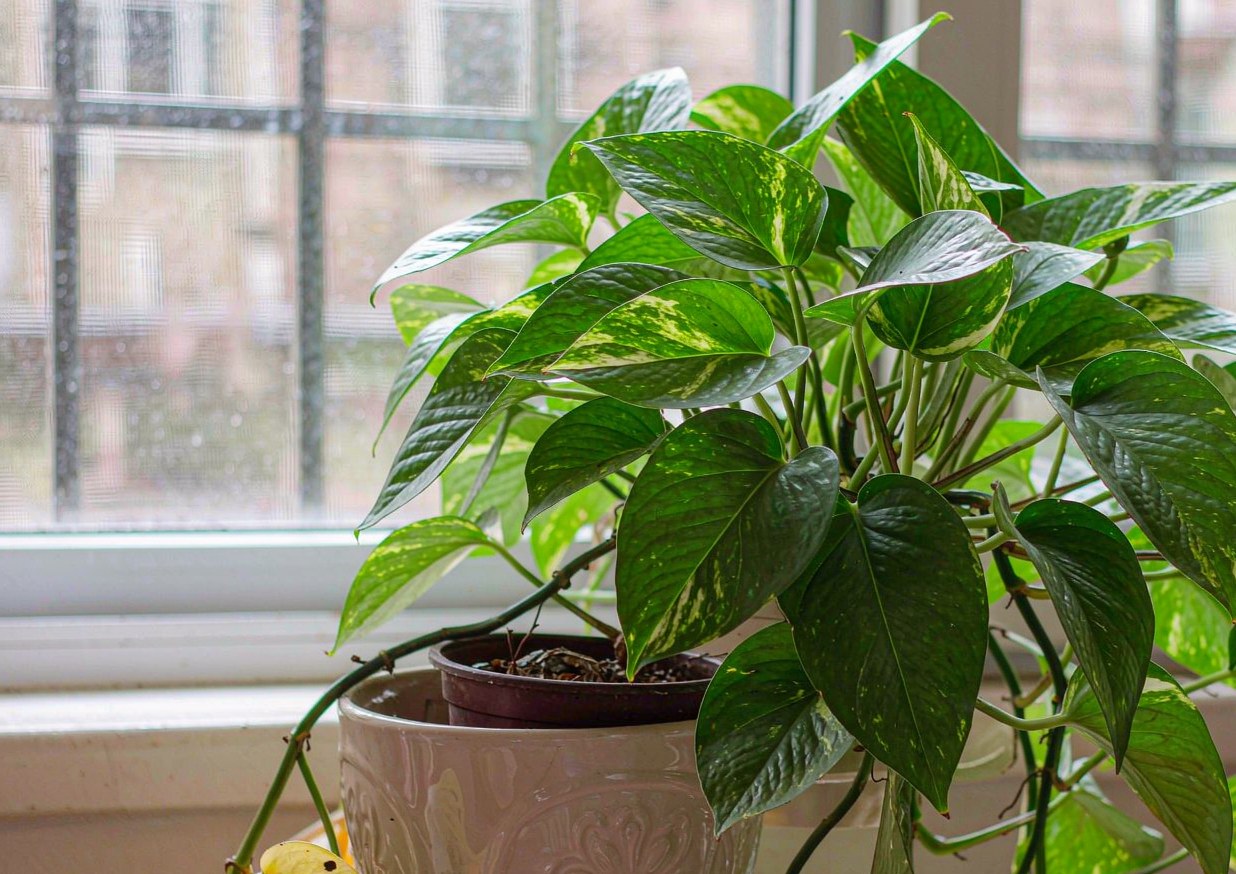
When potting mix stays saturated, the air pockets in it fill with water and the roots suffocate. Once they’re damaged they can’t take up water or nutrients even though they’re sitting in it, so the plant starts cannibalising its oldest leaves for whatever it can salvage — which is exactly why the yellowing shows up at the bottom first. The plant looks thirsty while it is drowning. Then the damaged tissue rots, and rot spreads. My pothos sat in a decorative ceramic pot with no drainage hole, which meant every drop I gave it stayed in the bottom, and the lower third of the root ball was dead before I noticed anything wrong above the soil. Check the mix with your finger two inches down before you ever reach for the can: cool and clinging means wait, dry and dusty means water. That one habit prevents most of what follows in this article.
What rot actually looks like
You cannot diagnose this from above the soil line, which is why guessing fails. You have to look, and it takes about ninety seconds.
Slide the plant out of its pot and look at the roots. Healthy pothos roots are firm and pale — white to light tan, with a slightly waxy feel, and they resist when you tug them gently. Rotted roots are dark brown to black, soft, and either mushy or hollow, and the outer sheath slides off in your fingers leaving a thin thread behind, which is why the symptom is called root rot rather than root death. There’s usually a smell, too: a sour, wet, slightly swampy odour that healthy potting mix simply doesn’t have. Mine smelled like a pond. Sniff the root ball before you do anything else — it’s the fastest diagnosis there is, and it costs nothing. If more than roughly half the root mass is gone, don’t try to save the whole plant: take cuttings from the healthy vine tips, root them in water, and start again. That’s what I did with the last two good vines, and both rooted within three weeks.
Cause Two: Underwatering and Dry Shock
The signs people misread as thirst
Underwatering genuinely does cause yellow leaves, and it’s the second most common cause after overwatering — but it looks nothing like the first, and the two get confused constantly.
The tell is that a thirsty pothos yellows from the leaf edge inward and the tissue goes crisp and brown rather than soft and limp. The whole plant also loses its gloss: healthy pothos leaves are slightly reflective, and a dry one goes matte and starts curling at the edges before the colour even changes. Growth stops too — the internodes get shorter and the new leaves come in small. I let a pothos go five weeks once while travelling, and it came back with eight crisp yellow leaves and not one soft one. The mistake people make with this is dumping a litre of water on a bone-dry root ball and walking away: severely dry potting mix is hydrophobic and the water runs straight down the inside of the pot and out the drain hole without wetting anything. Soak it at the sink instead, or better, stand the pot in a basin of water for twenty minutes and let it wick up from the bottom.
How to rehydrate without shocking it
Coming back from severe dryness is mostly a patience exercise, and doing it fast does more harm than the dryness did.
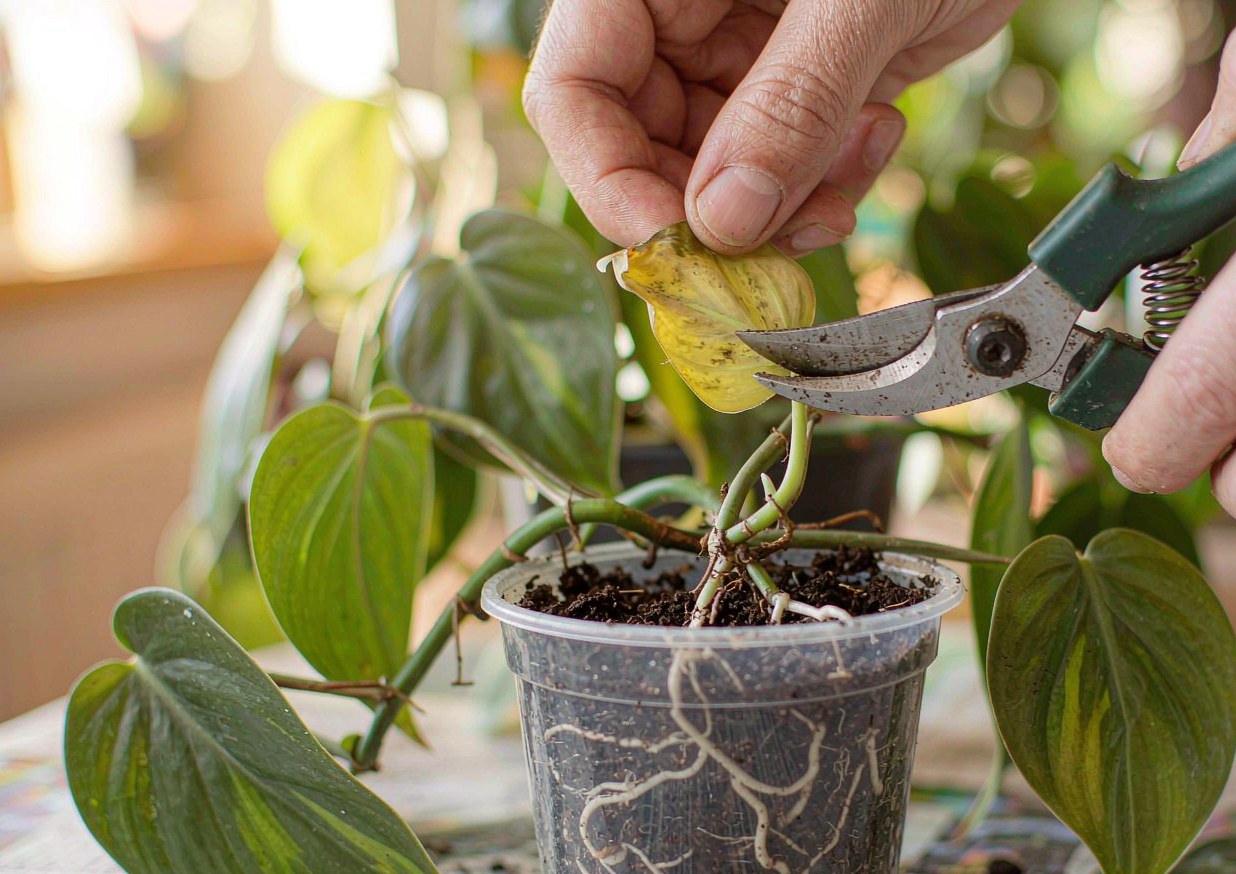
Here’s the sequence I use. First, take the pot to a sink or basin and let it soak from the bottom for twenty to thirty minutes until the surface of the mix is visibly damp. Second, let it drain completely — a full ten minutes, because a plant that’s been dry often has compromised roots and you don’t want it sitting wet. Third, cut off the leaves that are more than about half yellow; they will not turn green again, and the plant is better off putting energy into new growth. No leaf ever un-yellows. That’s worth repeating, because it’s the question I get most often. Fourth, give it a week in slightly lower light than usual while it recovers. Don’t fertilise a plant that’s just come back from drought — feeding damaged roots is like making somebody run on a sprained ankle, and I’ve burnt the leaf edges off a plant doing exactly that. Expect new growth in two to four weeks.
Cause Three: Light, Too Little and Too Much
Too little light, and why variegation fades
A pothos in a genuinely dark corner doesn’t usually die — it goes pale, thin and slow, and the yellowing is gradual and spread evenly across the plant rather than concentrated at the bottom.
Light drives photosynthesis, and when there isn’t enough of it the plant strips chlorophyll out of the leaves it can’t afford to maintain, which reads to us as yellowing. You’ll see it alongside two other signs: the variegation fades, so a golden or marble queen pothos starts producing almost solid green leaves, and the stems stretch, with long bare gaps between leaves as the vine hunts for light. Mine did exactly this on a bookshelf about nine feet from the window. That’s adaptation, not illness, and moving the plant closer to the window brings the colour back on new growth within a season. The practical fix is to get it within about six feet of a window, or onto a shelf where it gets bright indirect light for most of the day. Don’t move it into direct sun to compensate — that’s the next section, and it’s a faster way to lose leaves than the shade was.
Too much sun, and what scorch looks like
The opposite error is also common, because people correctly learn “pothos needs light” and then put it on a south windowsill. Direct sun burns pothos leaves, and the damage looks enough like overwatering to fool people.
Scorch shows up as pale, bleached, yellowish-white patches on the leaves facing the glass, usually with a dry brown centre as it progresses, and critically it appears on the leaves closest to the window rather than the oldest ones near the soil. That last detail is what separates it from a watering problem. A pothos will tolerate morning sun through an east window happily; what it won’t take is afternoon sun through south or west glass, particularly in summer when the glass amplifies it. I scorched one on a west-facing sill in July in about four days. The fix is simple: move it back a few feet, or hang a sheer curtain, and cut off the damaged leaves since they won’t recover. Note also that a plant moved suddenly from a dark room into bright light will scorch even at light levels it would otherwise handle — acclimatise it over two weeks, moving it a couple of feet closer every few days.
Cause Four: Pot, Soil and Drainage
The pot with no hole
If I had to name the single most common cause of yellowing pothos leaves that isn’t watering frequency, it’s the pot. Specifically, the pretty pot with no drainage hole.
Pothos is near the top of the list of plants people buy for a decorative pot, and a ceramic or cement cachepot with no hole turns every watering into a small flood at the bottom of the container where the roots sit. Two inches of standing water below the root ball is enough to rot a pothos within a couple of months. I killed mine this way. The fix, and it’s the one I use for every plant now: leave the pothos in its cheap plastic nursery pot with the holes in it, and drop that inside the decorative pot like a sleeve. Water it by lifting the inner pot out, soaking it at the sink, letting it drain for ten minutes, then putting it back. If you absolutely must plant directly into a pot with no hole, put a two-inch layer of coarse material at the bottom — though that’s a compromise, not a solution, because the wetted zone just moves upward. Also check the saucer: never let the pot stand in the water that drains out of it.
Compacted and exhausted mix
Potting mix has a working life. After two or three years it breaks down, compacts, and stops doing the one job that keeps roots healthy — holding both moisture and air.
You can diagnose this without lifting the plant: water it and watch how fast the water moves. If it pools on the surface and takes more than a few seconds to sink, the mix has compacted. If it runs straight through and out the bottom in seconds, the mix has broken down into dust or has pulled away from the sides of the pot in a gap, and the water is channeling down the inside wall without wetting the root ball at all. Both end in yellow leaves. I had a pothos in the same mix for four years and it hit the second state — I’d water it weekly and the middle of the root ball stayed bone dry, which is why I mistook it for underwatering and watered more. Refresh the mix every two to three years, and when you do, use a standard indoor mix with a handful of perlite worked through it. Check the pot size at the same time: only go up one or two inches, because a big jump in pot size leaves too much wet mix around a small root ball.
Cause Five: Age, Feeding and Minerals
Normal ageing, and how to tell it apart
Sometimes a yellow leaf is just a leaf retiring, and learning to recognise it will save you a lot of unnecessary panic and a lot of unnecessary repotting.
A pothos vine will drop its oldest leaf periodically, particularly on long established vines. The signature is that it’s one leaf at a time, always at the very bottom of a vine, and the rest of the plant — the new growth especially — looks completely healthy. The leaf yellows evenly, goes soft, and comes away with a gentle tug. That is a plant reallocating resources, and it’s normal. What isn’t normal is three or four leaves at once, or yellowing that appears on multiple vines simultaneously, or yellowing that’s climbing upward. I get one or two of these a month on a big plant and I don’t do anything about them except cut them off. Cut them where the leaf stalk meets the stem, with clean shears, ideally in the morning so the wound dries during the day. If you’re losing more than two leaves a month on a mature plant, though, go back to the top of this article — something on the list above is wrong.
Fertiliser, salt build-up and tap water
The last cause is the one people reach for first and should reach for last: food. Most yellowing pothos plants are not hungry, and feeding them makes it worse.
There are two feeding mistakes. The first is too much fertiliser, which leaves dissolved salts in the mix; you’ll see crisp brown tips and edges on the oldest leaves, often with a white crust on the terracotta or around the drain hole. The fix is to flush the pot — run water through it at the sink for a minute or two — and then stop feeding for a few months. The second is genuine deficiency from never feeding at all, which shows up as uniform paling on the new growth first and takes a year or more to appear. In between, standard tap water contributes: fluoride and chlorine affect some plants, and if your water is very hard, mineral deposits build up the same way. I feed my pothos once a month in spring and summer at half the label rate, and not at all from October through February, because a plant in a dim winter room isn’t growing and can’t use it. If the leaf edges are browning and you’ve been feeding, flush before you feed.
The Fix: A Step-by-Step Rescue
Twenty minutes of triage
When a pothos starts yellowing badly, this is the sequence I run, in this order. It takes about twenty minutes and it’s the same one I used on the plant I nearly lost.
Step one: feel the soil. Two inches down near the edge of the pot. Wet means skip to step three immediately. Step two: look at the light. How far is it from the window, and does any direct sun hit the leaves? Step three: slide the plant out and look at the roots, using the colour and texture test above. Step four: smell the root ball. Sour means rot, and you act today. Step five: decide. If less than half the roots are damaged, you’re rescuing the plant; if more than half are gone, you’re taking cuttings. Most people do these in the wrong order and end up repotting a plant whose actual problem was that it was sitting three feet from a heating vent. Doing it in this order means you fix the cause rather than the symptom, and it means you don’t put a struggling plant through the stress of a repot it didn’t need.
Repotting, pruning and taking cuttings
If the roots are damaged, this is the actual repair. Have everything ready before you start, because a bare-rooted pothos shouldn’t sit out for long.
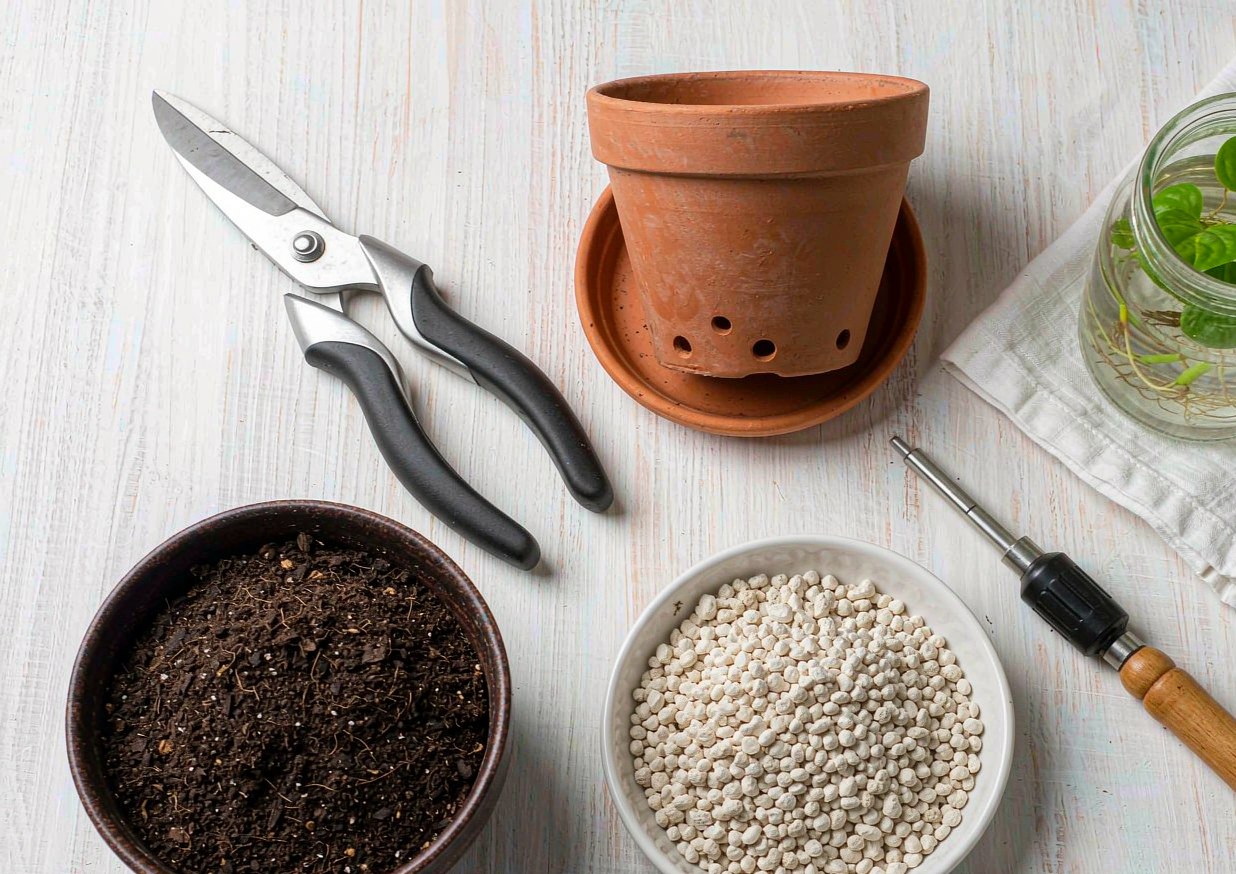
Lay out a clean pot with drainage holes, fresh indoor mix with perlite, and clean shears. Rinse the root ball under lukewarm water to wash the old mix off so you can see what you’re dealing with, then cut away everything dark, soft or hollow with clean shears — cut back to healthy tissue, and don’t be timid about it, because rotted roots left in place will keep rotting. If you’ve removed more than about a third of the root mass, cut the foliage back by roughly the same proportion to balance what the remaining roots can support, which feels brutal and is correct. Repot into fresh mix in a pot only an inch or two larger, water once thoroughly, and then leave it alone: no fertiliser for at least six weeks, and slightly lower light while it recovers. If the roots are mostly gone, skip all of that and take cuttings instead: cut below a node, put the cuttings in water, and you’ll have roots in two to three weeks. The two vines I rescued that way are now the biggest plants I own.
Prevention: The Routine That Keeps It Green
Watering by feel, not by date
Every cause on this list except ageing and scorch traces back to watering, so the prevention is a routine rather than a product. And the routine starts with abandoning the calendar.
My rule for a pothos in bright indirect light is the top two inches dry, then water thoroughly; in a dimmer room that stretches to the top third or more. In practice it’s roughly every seven to ten days in summer and every ten to fourteen in winter, but I never water on those numbers — I check with a finger, in two or three places around the pot, because the side nearest a vent dries first. When I do water, I take it to the sink and soak it until it runs freely out of the drain hole, then let it drain for ten minutes before it goes back. Never leave it in a saucer of water. A moisture meter costs about $12 and is worth it if you’ve got more than a few plants or anything in a pot over eight inches. Add one habit: lift the pot when you check it. A dry pot is startlingly light, and after a month you’ll be able to tell by weight without touching the soil at all.
Light, feeding and the annual check
Get the position right and most of the rest takes care of itself. A pothos wants bright indirect light — near a window, out of direct sun.
Concretely: within about six feet of an east or north window, or a few feet back from south or west glass, or behind a sheer curtain. That position gives you the strongest variegation and the fastest growth, and it’s the single change that fixed my bookshelf plant. Feeding, as above, is monthly at half strength through the growing season and nothing through the winter. Then once a year, do a check I now do every March: lift the plant, look at the roots, and decide whether it needs a bigger pot or just fresh mix. Pothos tolerates being slightly root-bound far better than being overpotted, so only go up a size if roots are genuinely circling the outside of the root ball. Wipe the leaves with a damp cloth while you’re at it — a dusty leaf in a dim room is photosynthesising even less than you’d think. That’s the whole routine: right light, water by feel, feed lightly, refresh the mix every two or three years.
Troubleshooting: Symptoms, Causes and Fixes
Every yellowing problem I’ve had with a pothos fits one of these eight lines. Find your symptom, then read the cause before you reach for the watering can.
| Symptom | Likely cause | Fix |
|---|---|---|
| Soft yellow leaves at the bottom, wet soil | Overwatering; roots suffocating | Stop watering, unpot and inspect roots, cut rot, repot into fresh mix |
| Crisp yellow leaves with brown tips, bone-dry soil | Underwatering, or hydrophobic mix | Soak from the bottom for 20–30 minutes, drain fully, cut spent leaves |
| Whole plant paling evenly, variegation fading | Too little light | Move within six feet of a window, or add a grow light on a timer |
| Bleached yellow-white patches on window-facing leaves | Sun scorch | Move back from the glass or hang a sheer curtain; acclimatise over two weeks |
| Yellowing with a sour smell from the pot | Root rot | Unpot, rinse roots, cut all dark soft tissue, repot; take cuttings if over half is gone |
| One yellow leaf at a time on the oldest vine | Normal ageing | Nothing — cut it off at the stem and carry on |
| Crisp brown tips with white crust on the pot | Fertiliser salt build-up | Flush the pot with water for a minute, then stop feeding for a season |
| Water runs straight through without wetting the mix | Compacted or channeled old mix | Refresh the mix every 2–3 years; add perlite; check pot size |
FAQs
Why are the bottom leaves on my pothos turning yellow?
In about seven cases out of ten it’s overwatering, and the reason the bottom goes first is that a damaged root system can’t supply the whole plant, so it sacrifices the oldest, least efficient leaves first. Push your finger two inches into the mix: if it’s cool and clinging, stop watering immediately and slide the plant out to check the roots — healthy ones are firm and pale, rotted ones are dark, soft and smell sour. The other possibilities are normal ageing, which is one leaf at a time on the oldest vine with the rest of the plant looking great, and nitrogen or salt issues, which are much less common than people assume. Do not water a plant whose soil is already wet. That is the mistake I made for a month, and it cost me eleven leaves.
Can yellow pothos leaves turn green again?
No. Once the chlorophyll is gone from a leaf, it’s gone permanently, and no amount of water, fertiliser or light will bring the green back into that specific leaf. What you can do is work out why it happened so the next twenty leaves stay green. Cut the yellowed leaf off where its stalk meets the stem, using clean shears, once it’s more than about half yellow — leaving it attached costs the plant energy it could spend on new growth. Watch the new growth instead of the old leaves: if the next few leaves come in healthy and properly coloured, the fix worked, and the plant will outgrow the damage in a season or two.
How often should I water a pothos?
When the top two inches of mix are dry, which in bright indirect light is roughly every seven to ten days in summer and every ten to fourteen in winter. Never on a schedule — light, temperature and pot size all shift that number, and a calendar doesn’t know that December light is a fraction of July light. I check by pushing a finger two inches into the mix in two or three places around the pot, because the side nearest a heating vent dries first, and I confirm by lifting the pot, since a dry one is surprisingly light. When you do water, soak it at the sink until it runs freely out of the drainage holes, let it drain for ten minutes, and never let it stand in the saucer.
Is a pothos safe to have around cats and dogs?
No — pothos is commonly listed as problematic for cats and dogs, and the leaves are exactly the dangling, chewable shape that attracts them. Mine knocked a plant off a shelf and spent twenty minutes with it before I noticed. If you have a chewer, hang it somewhere genuinely out of reach, not somewhere you hope it won’t go, and check any plant you’re unsure about against the ASPCA plant listing before bringing it home, because the common name “pothos” gets printed on labels for several different plants at garden centres. To be explicit, this is general houseplant information and not veterinary advice: if you think a pet or a child has actually eaten part of a pothos, call your vet or the ASPCA Animal Poison Control Center at (888) 426-4435 rather than waiting to see what happens.
Should I fertilise a pothos with yellow leaves?
Almost certainly not yet. Feeding a plant whose roots are damaged or whose problem is water or light adds salt to a system that can’t use it, and you’ll get crisp brown tips on top of the yellow you already had. Work through the causes in order first — water, roots, light, pot — and only consider food if the plant has been in the same mix for over two years and the pale new growth is uniform rather than patchy. When you do feed, use a balanced houseplant fertiliser at half the label rate, monthly through spring and summer, and nothing from October through February. If you see brown tips and a white crust around the drain hole, you’ve overfed: flush the pot at the sink and stop.
Sources and Further Reading
- ASPCA — Pothos (Toxic and Non-Toxic Plants List)
- ASPCA — Animal Poison Control Center
- Missouri Botanical Garden — Plant Finder
- Wisconsin Horticulture — Houseplant Care Articles
- RHS — Houseplant Advice
About the author
Samantha has been gardening and arranging her own cut flowers for more than ten years, and has built more than 30 centerpieces from grocery-store bunches, clippings off the cedars behind her house, and a handful of dollar-store experiments that didn’t work. She writes practical, low-cost guides for beginners, including the versions that failed. Prices quoted in her articles are what she actually paid at US grocery and craft stores; nothing is sponsored and no brand pays for a mention. She is not a certified florist, a veterinarian or a horticulturist, and says so wherever a topic touches on plant safety or pet health.
Published: Oct 19, 2026 · Last updated: Oct 19, 2026.
{
“@context”: “https://schema.org”,
“@graph”: [
{
“@type”: “Article”,
“headline”: “Why Pothos Leaves Turn Yellow and How to Fix It”,
“description”: “Yellow pothos leaves are a message with a location attached. Read the pattern, find the cause among five possibilities, and run the 20-minute rescue that saves the plant.”,
“image”: [
“https://gmmur.com/wp-content/uploads/sites/5/2026/10/pothos-hero-clean.jpg”,
“https://gmmur.com/wp-content/uploads/sites/5/2026/10/pothos-materials-clean.jpg”,
“https://gmmur.com/wp-content/uploads/sites/5/2026/10/pothos-process-clean.jpg”
],
“author”: { “@type”: “Person”, “name”: “Samantha” },
“publisher”: { “@type”: “Organization”, “name”: “Gmmur” },
“datePublished”: “2026-10-19”,
“dateModified”: “2026-10-19”,
“mainEntityOfPage”: {
“@type”: “WebPage”,
“@id”: “https://gmmur.com/pothos-leaves-turning-yellow-fix”
}
},
{
“@type”: “FAQPage”,
“mainEntity”: [
{
“@type”: “Question”,
“name”: “Why are the bottom leaves on my pothos turning yellow?”,
“acceptedAnswer”: {
“@type”: “Answer”,
“text”: “In about seven cases out of ten it is overwatering. A damaged root system cannot supply the whole plant, so the plant sacrifices its oldest leaves first. Push a finger two inches into the mix: if it is cool and clinging, stop watering and check the roots. Healthy roots are firm and pale; rotted roots are dark, soft and smell sour.”
}
},
{
“@type”: “Question”,
“name”: “Can yellow pothos leaves turn green again?”,
“acceptedAnswer”: {
“@type”: “Answer”,
“text”: “No. Once chlorophyll is gone from a leaf it cannot return. Cut the leaf off where its stalk meets the stem once it is more than about half yellow, then watch the new growth: if the next leaves come in healthy and properly coloured, the fix worked.”
}
},
{
“@type”: “Question”,
“name”: “How often should I water a pothos?”,
“acceptedAnswer”: {
“@type”: “Answer”,
“text”: “When the top two inches of mix are dry: roughly every seven to ten days in summer and every ten to fourteen in winter in bright indirect light. Never water on a schedule. Check with a finger in two or three places, soak thoroughly at the sink, drain for ten minutes, and never leave it in a saucer of water.”
}
},
{
“@type”: “Question”,
“name”: “Is a pothos safe to have around cats and dogs?”,
“acceptedAnswer”: {
“@type”: “Answer”,
“text”: “No. Pothos is commonly listed as problematic for cats and dogs, and the trailing leaves attract chewing. Hang it genuinely out of reach and check any plant against the ASPCA list before buying, since the common name is printed on several different plants. This is general information, not veterinary advice: if a pet or child eats part of a pothos, call your vet or the ASPCA Animal Poison Control Center at (888) 426-4435.”
}
},
{
“@type”: “Question”,
“name”: “Should I fertilise a pothos with yellow leaves?”,
“acceptedAnswer”: {
“@type”: “Answer”,
“text”: “Not yet. Feeding a plant with damaged roots adds salt it cannot use and produces crisp brown tips on top of the yellow. Work through water, roots, light and pot first; then feed at half the label rate monthly through spring and summer and nothing from October through February.”
}
}
]
}
]
}