
The first winter I spent in a north-facing apartment, I killed four houseplants in five months: a fiddle leaf fig, a string of pearls, a calathea that cost me $34 and a “low light” fern that the tag swore was indestructible. I did everything the tags told me to do, and every single one of them rotted from the bottom up. What finally fixed it wasn’t a better plant — it was realising that low light isn’t a vibe, it’s a measurement, and that a plant sitting in a genuinely dim room uses roughly a third of the water the same plant uses near a bright window. Once I matched the plant to the actual light and cut my watering to match, the dying stopped. Below are the seven that survived, the light test I run before I buy anything, and the watering mistake that killed the other four.
Quick answer: three things decide whether a plant survives a dark apartment. First, measure the light before you shop: hold your hand a foot above the spot at midday and look at the shadow — a soft, blurry edge means genuinely low light, a sharp edge means you have more than you think. Second, buy from the short list that tolerates it: snake plant, ZZ plant, cast iron plant, pothos, heartleaf philodendron, peace lily and Chinese evergreen. Third, water by feel, not by calendar — in low light, most of these want the top two inches of soil completely dry before they see water again, and the two succulent-ish ones want the pot dry almost all the way through. Get those three right and a $18 plant lasts for years instead of five months.
- 1. What “Low Light” Actually Means
- 2. How I Picked These Seven
- 3. The Seven Plants at a Glance
- 4. Snake Plant and ZZ Plant: The Two Safest Bets
- 5. Pothos and Heartleaf Philodendron: Trailing Plants for Shelves
- 6. Cast Iron Plant, Peace Lily and Chinese Evergreen
- 7. Watering in a Dark Room
- 8. Soil, Pots and Grow Lights
- 9. Troubleshooting: Symptoms, Causes and Fixes
- 10. FAQs
- 11. Sources and Further Reading
What “Low Light” Actually Means
The shadow test, and how to read your own rooms
Plant tags say low light because it sells plants. The phrase has no legal definition, and that’s why my fern died under a tag that promised otherwise. What you actually need is a rough sense of how much light your room delivers, and you can get it without buying anything.
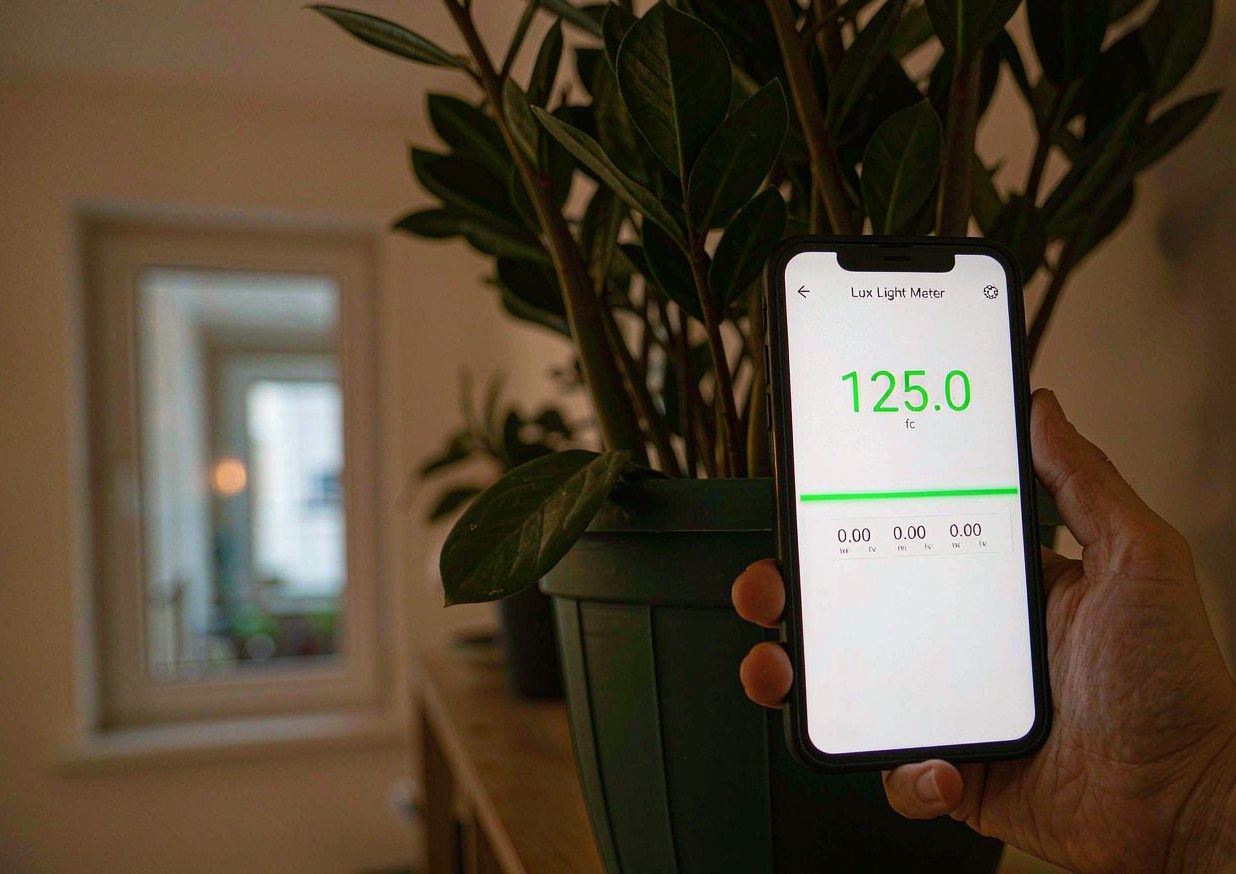
Here’s the test I use now. On a bright day around midday, hold your hand about a foot above the spot where the plant would sit and look at the shadow it casts on the surface below. A sharp-edged, dark shadow means bright indirect light. A soft shadow you can still make out means medium. A faint smudge with no real edge at all means low light — the kind of spot where you’d need a lamp to read by in the daytime. That last one is what most people mean by a dark apartment, and it’s a genuinely hostile environment for almost everything sold as a houseplant. I run this test in every room before I buy, because the difference between the corner eight feet from my north window and the shelf three feet from it is the difference between a plant that grows and a plant that merely survives. If you want a number instead of a shadow, most phone light-meter apps will read the room in foot-candles, and anything under about 100 is what I’d call low.
Why low-light plants still need some light
Every plant on my list tolerates shade, but tolerates is doing a lot of work in that sentence. None of them will grow in a closet, and none of them will grow under a bed.
A plant is running two processes at once: photosynthesis, which builds sugar out of light, and respiration, which burns that sugar to stay alive. Light feeds the first, temperature drives the second. In a dim room, photosynthesis crawls, so the plant lives on whatever reserves it stored — and if it can’t replace them, it slowly starves while looking perfectly fine for months. That’s exactly what happened to my calathea: it didn’t collapse, it just stopped producing new leaves and then quietly gave up over about ten weeks. The practical takeaway is that low light means slow growth, not zero growth, and you should expect a plant to produce a handful of new leaves a year rather than a handful a month. The corollary matters as much: because photosynthesis is slow, water use is slow too. Water on the same schedule you’d use in a sunroom and you drown the roots, which is what killed all four of mine.
How I Picked These Seven
The three things that disqualified almost everything else
I’ve bought somewhere north of 40 houseplants over ten years, and most of them are gone. Sorting out why gave me three disqualifiers that rule out the majority of what garden centres stock.
The first disqualifier is any plant that needs direct sun to hold its shape. That’s the fiddle leaf fig, most succulents, anything with silver or fuzzy leaves, and every cactus — they stretch and flop toward the window in a dim room within a season. The second is anything that demands humidity above about 50%, which is ferns, calatheas and most prayer plants. My apartment sits near 30% all winter with the heat on, and I learned that misting does essentially nothing about it. The third is anything that resents drying out completely, because the whole point of a low-light plant is that you’ll water it rarely and unevenly. What’s left after those three cuts is a short, boring, extremely tough list — and boring is exactly what you want in a dark apartment.
The scoring I actually used
Four scores, and a plant has to clear all four to make my list.
Survival — does it still look like a plant after a winter with no direct sun? Forgiveness — does it bounce back if I forget it for three weeks, or does it hold a grudge? Cost — can I replace it for under $25 if it dies anyway? Pet and child safety — and this one cuts a lot of popular plants, since pothos, philodendron, peace lily and Chinese evergreen are all listed as problematic if chewed. None of those four is optional for me anymore. I lost a whole shelf of plants to the mistake of buying whatever looked good and sorting out the light afterwards; now I measure first and buy second.
The Seven Plants at a Glance
Light, water, growth rate and the pet column
This is the table I wish I’d taped to the inside of my plant shelf in year one. Watering intervals assume a typical indoor temperature and a pot with drainage.
| Plant | Lowest light it tolerates | Water when | Growth in low light | Pet note |
|---|---|---|---|---|
| Snake plant | Very low — survives a dim corner | Pot dry nearly through | Slow, 2–4 new leaves a year | Listed as problematic if chewed |
| ZZ plant | Very low — the toughest on the list | Pot dry nearly through | Very slow | Listed as problematic if chewed |
| Cast iron plant | Low — tolerates deep shade | Top 2 in dry | Slow but steady | Generally regarded as the safer choice |
| Pothos | Low — colour fades without light | Top 2 in dry | Slow, still trails | Listed as problematic if chewed |
| Heartleaf philodendron | Low | Top 2 in dry | Slow to moderate | Listed as problematic if chewed |
| Peace lily | Low, but flowers need more | Top inch dry; it wilts loudly | Moderate | Listed as problematic if chewed |
| Chinese evergreen | Low — one of the best for offices | Top 2 in dry | Slow | Listed as problematic if chewed |
Read the growth column honestly before you buy. In a dark apartment none of these are fast, and a plant that produces four leaves a year is not going to fill a bare corner by spring — it’ll take two or three years. The pet column is the one I’d push hardest: five of my seven are on the problematic list, and if you have a cat that chews, cast iron plant and a parlor palm are the ones I’d build around instead.
What to skip if you have pets or small children
Being blunt about this saves a phone call to the vet. Five of the seven plants above are commonly listed as causing oral irritation and digestive upset in cats and dogs, and that includes two of the most-recommended beginner plants on the internet.
Pothos, heartleaf philodendron, peace lily, Chinese evergreen, snake plant and ZZ plant all contain calcium-oxalate crystals or similar irritants, and a chewing cat is the classic scenario. Mine knocked a pothos off a shelf and spent twenty minutes with the leaves before I noticed, and I spent the next hour on the phone. Nothing came of it, but I moved every plant above the cat’s jump line that afternoon. If you have a chewer, build the room around cast iron plant, parlor palm, spider plant, Boston fern or a calathea — and if you already own something questionable, put it somewhere the animal genuinely can’t reach rather than somewhere you hope it won’t go. Check any plant you’re unsure about against the ASPCA toxic and non-toxic plant list before you bring it home, because common names get swapped around at garden centres and “pothos” gets printed on labels for three different plants.
To be explicit: this is general houseplant information, not veterinary advice. I’m not a vet, and no plant list is exhaustive. If you think a pet or a child has actually eaten part of a plant, call your vet or the ASPCA Animal Poison Control Center at (888) 426-4435 rather than waiting to see what happens.
Snake Plant and ZZ Plant: The Two Safest Bets
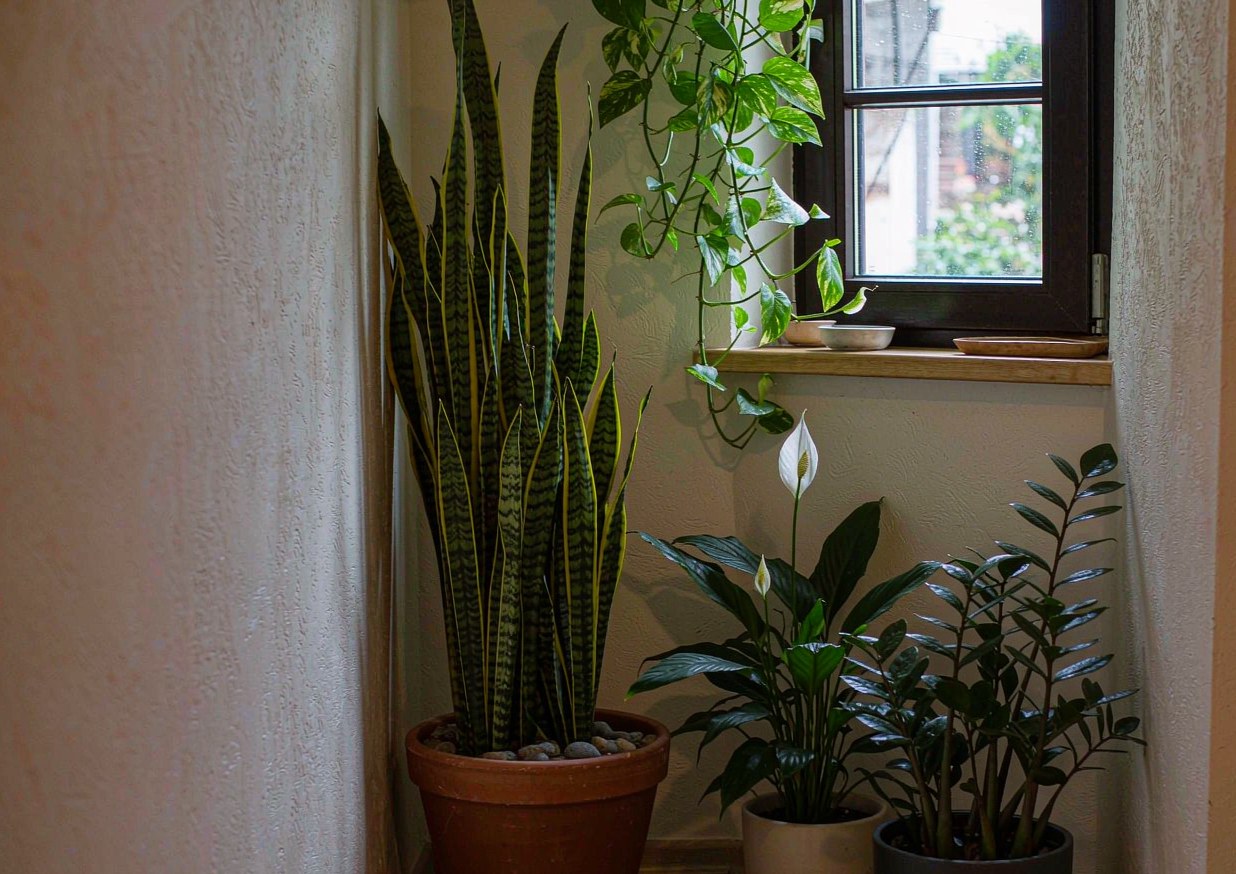
Snake plant: the one that forgives everything except kindness
If you buy one plant for a dark apartment, buy a snake plant. It tolerates the dimmest corner in my home, and the only way I’ve ever harmed one is by being generous with water.
I keep mine about eight feet from a north window, which by the shadow test is as low as light gets indoors, and it has put out two to four new leaves every year for six years without complaint. The routine is almost offensively simple: wait until the pot is dry almost all the way down, then water thoroughly and let it drain. In practice that’s every four to six weeks in winter and every three weeks in summer. Two things do kill it, and I’ve done both. The first is watering on a schedule — a snake plant in low light that gets watered weekly will rot at the base, and by the time the leaves go soft the rhizome is already gone. The second is cold: leave it against a drafty single-pane window in January and the leaves collapse into mush, which cost me three of them one winter. Give it a pot with drainage, a lean mix, and genuine neglect, and it will outlive the apartment.
ZZ plant: tougher, slower, and genuinely indifferent to you
The ZZ plant is the one I recommend to people who have killed a snake plant, which is a sentence I never expected to write. It stores water in thick underground rhizomes and glossy leaflets, and it is comfortable in light that would finish off nearly anything else.
The trade-off is time. A ZZ plant in a dim room does almost nothing visibly for months, and new shoots come up from the soil on their own schedule — mine sat untouched for a full season and then pushed out four stems in about six weeks. That’s normal, and the mistake people make is deciding it’s unhappy and watering it more, which is the fastest route to rot. I water mine roughly every five to six weeks in winter. One caution specific to this plant: those rhizomes fill the pot fast, so expect to repot every two or three years, and check that the pot has real drainage holes rather than a decorative outer cachepot, because a ZZ plant standing in water at the bottom of a closed pot will rot within a couple of months. That’s the whole routine.
Pothos and Heartleaf Philodendron: Trailing Plants for Shelves
Why pothos is the best shelf plant in a dark room
Pothos is the plant that makes a dark apartment look like someone lives there, because it trails. Nothing else on this list gives you six feet of green hanging off a shelf.
I have a golden pothos on a high shelf about six feet from my north window, and it has never once complained about the light. What light does change is the variegation: in a dim room a golden or marble queen pothos starts producing leaves with less and less white in them, and after a year or two the new growth is nearly solid green. That’s the plant adapting, not the plant dying. If you want the variegation back, move it closer to the window for the summer and it’ll return. Watering is the part that matters — I let the top two inches go dry, which in that spot is roughly every ten days to two weeks in winter. The failure mode is again overwatering, and the tell is yellowing on the lower leaves while the top of the plant still looks fine. If you see that, stop watering, check the roots, and cut back.
Heartleaf philodendron: the same job, a softer leaf
Heartleaf philodendron does everything pothos does with a thinner, softer, more matte leaf. If you’ve ever been sold a “pothos” that turned out to be neither, this is usually what it was.
The two get swapped constantly at garden centres, and the practical differences are small: heartleaf philodendron tolerates slightly less light than pothos and grows a little faster once it settles, but its leaves bruise more easily and it shows water stress faster. I run it on the same rule — top two inches dry, then water — and mine lives in the bathroom, where the light is low and the humidity is higher than the rest of the apartment, which suits it. One thing I’d flag from experience: it climbs if you give it something to climb, and it trails if you don’t. Mine spent two years as a messy trailing plant before I put a small moss pole in the pot, and within one season it had leaves twice the size. Bigger leaves are what more people want than more leaves. Both plants propagate absurdly easily in water, which means one $15 plant can become six plants over a couple of years.
Cast Iron Plant, Peace Lily and Chinese Evergreen
Cast iron plant and peace lily: two opposite personalities
These two solve different problems. Cast iron plant is the one you put in the darkest corner and forget; peace lily is the one you put somewhere you’ll actually see it, because it tells you when it’s thirsty.
Cast iron plant earned its name honestly. Mine sits in a hallway with no window at all — a fixture light comes on for maybe an hour a day — and it has held six or seven leaves steady for three years without losing one. It is slow in a way that tests your patience: expect one or two new leaves a year and nothing more. But it doesn’t drop leaves, doesn’t sulk, and tolerates drafts and dry heat that would finish off the rest of this list. Peace lily is the opposite character entirely. It wilts dramatically — fully collapsed leaves, the whole plant flat against the pot — and then recovers completely within a couple of hours of watering. I thought I’d killed mine the first time it did that. The wilt is not damage, it’s a message. The catch is that a peace lily in low light will not flower; you need medium light for the white spathes, so in a dark apartment it’s strictly a foliage plant. Water it when the top inch is dry and never let it sit in a saucer of water.
Chinese evergreen: the most underrated plant on the list
Chinese evergreen is the plant I’d put in an office cubicle, a windowless bathroom or a hallway, and it’s the one I see recommended least often despite being among the most tolerant.
Mine has been in the same spot — about ten feet from the north window, effectively deep shade by mid-afternoon — for four years, and it has never dropped a leaf or lost its colour. That’s the part that surprised me: where a pothos slowly fades toward solid green in the dark, Chinese evergreen holds its pink or silver variegation in light that would bleach most plants. It also handles dry heated air better than anything else on this list, which matters if you live somewhere with real winters. Watering is the standard low-light rule — top two inches dry, then water thoroughly. The one genuine caution is temperature: it dislikes anything under about 60°F, so keep it away from a cold window in January. If you want a plant with colour rather than plain green in a dark room, this is the one to spend your money on.
Watering in a Dark Room
Why low light means watering less, not more
This is the section that would have saved my four dead plants. Light drives water use. A plant in a dark room is barely photosynthesising, barely moving water up through its leaves, and it will sit in wet soil for weeks without doing anything with it.
Here is what that looks like in practice. The same six-inch pothos needs water every seven days near a bright east window and every ten to fourteen days six feet into the room. The same snake plant goes from every two weeks in bright indirect light to every four to six weeks in a dim corner. Nothing about the plant changed — only the light. Watering on a calendar is the single most common way people kill low-light houseplants, because the calendar doesn’t know that December light is a fraction of July light. The fix is to stop guessing: water by feel, and let the plant, not the date, decide. If you take one thing from this article, take that one.
How to check moisture without guessing
Three methods, in ascending order of reliability. I use all three depending on the plant, and only one of them costs money.
First, the finger test: push your index finger two inches into the mix near the edge of the pot. Dry and dusty means water; cool and slightly clinging means wait. Second, the weight test: lift the pot. A dry pot is startlingly light, and after a few weeks you’ll be able to tell by lifting alone — this is what I use for the plants on high shelves I can’t reach easily. Third, a moisture meter, which runs about $10 to $15 and is worth it if you have more than a handful of plants or anything in a pot bigger than eight inches. Whichever method you use, check in two or three spots around the pot, because mix dries unevenly and the side nearest a heating vent will be bone-dry while the far side is still wet. When you do water, water thoroughly — take it to the sink, soak until it runs out of the drainage holes, let it drain for ten minutes, then put it back. Never leave it standing in the saucer. That habit, plus checking by feel instead of by date, is the whole skill.
Soil, Pots and Grow Lights
The mix and the pot that keep roots alive
Most houseplant deaths I’ve diagnosed for friends were soil problems wearing a watering problem’s clothes. If the mix holds water like a sponge, no watering schedule will save the plant.
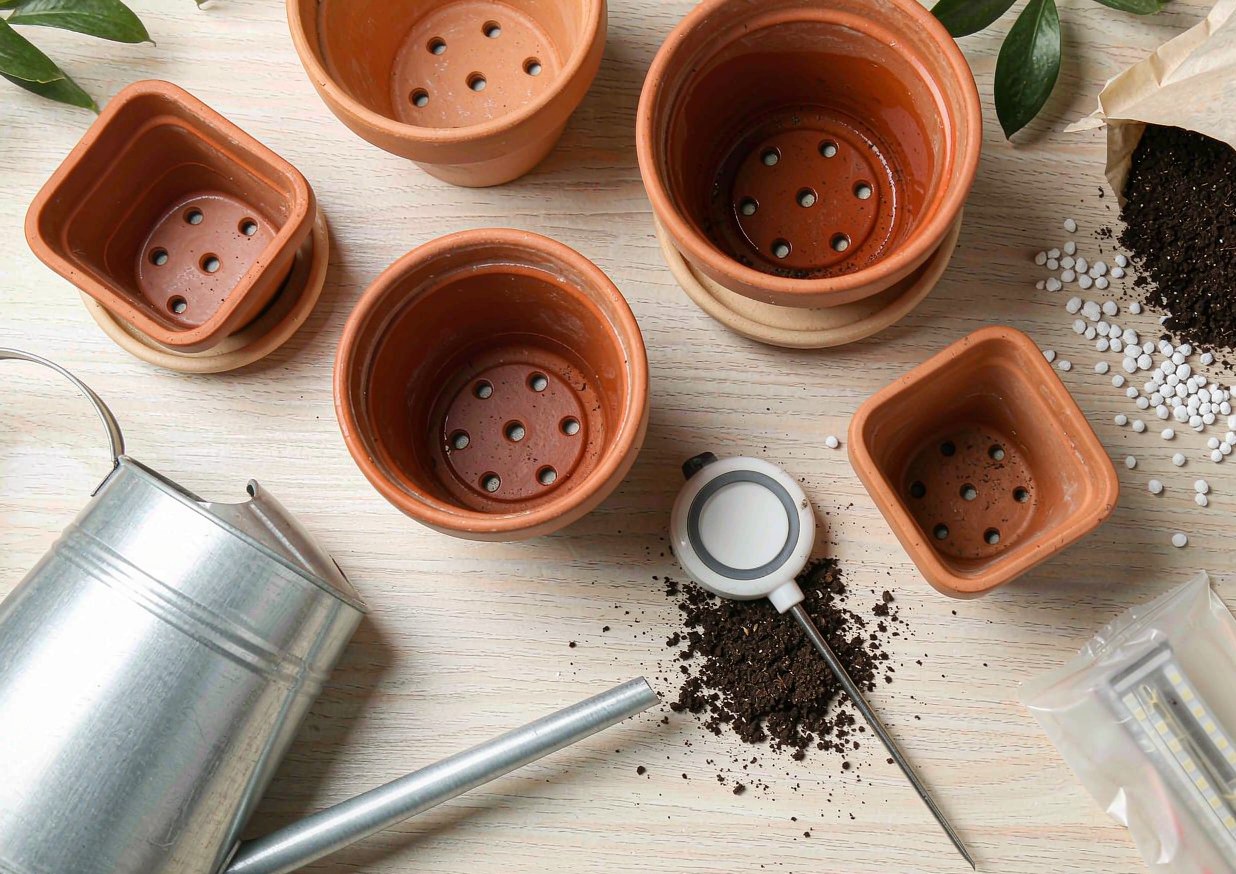
What I use for everything on this list is a standard indoor potting mix with perlite worked through it — roughly one part perlite to four parts mix for the foliage plants, and up to one part in three for the snake plant and ZZ plant. Do not use garden soil; it compacts in a container within a few months and suffocates the roots. The pot matters just as much: it needs real drainage holes, and I’ll say it plainly — a decorative pot without holes is a cachepot, not a planter. Keep the plant in its cheap plastic nursery pot and drop that inside the pretty one, lifting it out to water. Terracotta is my default for the snake plant and ZZ plant because it wicks moisture out of the mix and buys me a margin of error; glazed ceramic holds water longer and suits the peace lily and Chinese evergreen. One more thing that saves money long-term: repot into a pot only one or two inches wider than the current one. Jumping a plant from a six-inch pot to a twelve-inch pot buries the root ball in wet soil it can’t use, and that’s how a healthy plant rots after being “upgraded.”
When a grow light is actually worth buying
I resisted grow lights for years because they felt like admitting defeat. They aren’t — they’re the difference between surviving and growing, and in a genuinely dark apartment they’re sometimes the only way to keep certain plants at all.
The rule I use is simple: if a plant has stopped producing new leaves entirely for a full growing season and the shadow test says low, it wants more light than the room gives it. At that point a basic full-spectrum LED fixture — a shop light or a clamp lamp, roughly $20 to $45 — run for 10 to 12 hours a day and positioned 12 to 24 inches above the foliage will change everything. Mine runs on a cheap mechanical outlet timer so I never think about it. Two cautions from my own mistakes: more hours is not better, since plants need a dark period and 16-plus hours of light causes its own problems; and a grow light in a living space is bright enough to be annoying, so pick a warm-white spectrum around 3000K to 4000K if it’s going to be in a room you use in the evening rather than the harsh purple panels. If you’re building a plant shelf in a dark apartment, one fixture over the shelf covers four or five plants and costs less than replacing two dead ones.
Troubleshooting: Symptoms, Causes and Fixes
Nearly every problem I’ve had with a low-light plant traces back to one of seven causes. This is the table I check first now, in the order the symptoms usually show up.
| Symptom | Likely cause | Fix |
|---|---|---|
| Lower leaves yellowing, top of the plant fine | Overwatering — the classic low-light mistake | Stop watering, check the roots, trim anything soft and brown, switch to the two-inch finger test |
| Leaves go soft and collapse from the base | Rot from standing water or no drainage | Lift the plant out, cut rotted roots, repot into dry mix with perlite, pot must have holes |
| No new growth for a full season | Too little light, or it’s simply winter | Re-run the shadow test, move it closer to the window, or add a grow light on a timer |
| Stretching, with long gaps between leaves | Reaching for light it can’t find | Move it within three feet of the window, or prune back to a node and add light |
| Variegation fading to plain green | Normal adaptation to low light | Not damage — move it brighter for summer and the colour returns on new growth |
| Crisp brown leaf edges and tips | Dry heated air, or salt build-up from fertiliser | Move off the heating vent, flush the pot with water once, hold off on fertiliser in low light |
| Plant wilts dramatically, then recovers after watering | Peace lily being a peace lily | Normal for that species — water when the top inch is dry and never let it sit in water |
FAQs
What actually counts as low light in an apartment?
Practically, it’s a spot where you’d need a lamp to read comfortably in the middle of the day. My test is the shadow: hold your hand a foot above the surface at midday and if the shadow is a soft smudge with no defined edge, that’s low light, and you should shop from the tolerant end of the list — snake plant, ZZ plant, cast iron plant, Chinese evergreen. For a number, phone light-meter apps will read the room in foot-candles and anything under about 100 is genuinely low. Measure before you buy rather than after, because the tag on the plant is marketing, not a measurement, and that mismatch is what killed the first four plants I bought for my north-facing apartment.
How often should I water plants in a dark room?
Far less often than you think, and by feel rather than by calendar. Light drives water use, so a plant that needs water every seven days near a bright window may need it every two to three weeks six feet into the same room — and a snake plant or ZZ plant in a genuinely dim corner can go four to six weeks. My rule is the two-inch finger test for the foliage plants (pothos, philodendron, peace lily, Chinese evergreen, cast iron plant) and near-total dryness for snake plant and ZZ plant. When you do water, soak it thoroughly at the sink, let it drain for ten minutes, and never leave it standing in a saucer. Watering on a schedule is the single most common way people kill low-light plants, and it’s exactly how I lost my calathea.
Which of these plants is safest around cats and dogs?
Of my seven, cast iron plant is the one I’d call the safer choice, and a parlor palm or spider plant is safer still if you want a trailing plant. Pothos, heartleaf philodendron, peace lily, Chinese evergreen, snake plant and ZZ plant are all commonly listed as causing oral irritation and digestive upset in cats and dogs, so they belong above a jump line or in a room the animal doesn’t use. I learned this the hard way when my cat spent twenty minutes with a pothos leaf I’d left on a low shelf. Check any plant against the ASPCA toxic and non-toxic plant list before you buy it, because common names get printed on the wrong plants at garden centres more often than you’d expect. And to be clear, that’s general information and not veterinary advice — if a pet or a child actually eats part of a plant, call your vet or the ASPCA Animal Poison Control Center at (888) 426-4435.
Do low-light houseplants need fertiliser?
Barely, and less than the bottle says. In low light a plant is growing slowly, so it’s using very little nutrient, and the usual mistake is feeding a plant that can’t use the food — the salts accumulate in the mix and you get crisp brown leaf edges that look like a watering problem but aren’t. I feed my low-light plants twice a year, in late spring and midsummer, at roughly half the label rate, and I skip it entirely from October through February when growth has stopped. Plants in the darkest corners get nothing at all. If you do see brown tips and you’ve been feeding regularly, flush the pot by running water through it at the sink for a minute or two and then stop feeding for a season. Newly repotted plants don’t need fertiliser for a couple of months either, since fresh mix already contains some.
Is a grow light worth it, or should I just buy tougher plants?
Both, and which one first depends on what you want. If you want plants that simply stay alive and look green, buy tougher plants and skip the light — a snake plant, a ZZ plant and a cast iron plant will handle a dark apartment indefinitely with nothing extra. If you want plants that actually grow, put out new leaves and hold their variegation, a light is the only real answer in a dim room. A basic full-spectrum LED fixture runs $20 to $45, sits 12 to 24 inches above the foliage, and runs 10 to 12 hours a day on an outlet timer. Buy warm-white around 3000K to 4000K if it’s going in a room you use in the evening, and don’t run it past about 12 hours, because plants need a dark period.
Sources and Further Reading
- ASPCA — Toxic and Non-Toxic Plants List
- ASPCA — Animal Poison Control Center
- Missouri Botanical Garden — Plant Finder
- RHS — Houseplant Advice
- Wisconsin Horticulture — Houseplant Care Articles
About the author
Samantha has been gardening and arranging her own cut flowers for more than ten years, and has built more than 30 centerpieces from grocery-store bunches, clippings off the cedars behind her house, and a handful of dollar-store experiments that didn’t work. She writes practical, low-cost guides for beginners, including the versions that failed. Prices quoted in her articles are what she actually paid at US grocery and craft stores; nothing is sponsored and no brand pays for a mention. She is not a certified florist, a veterinarian or a horticulturist, and says so wherever a topic touches on plant safety or pet health.
Published: Oct 19, 2026 · Last updated: Oct 19, 2026.
{
“@context”: “https://schema.org”,
“@graph”: [
{
“@type”: “Article”,
“headline”: “7 Low-Light Houseplants That Survive a Dark Apartment”,
“description”: “Measure your light before you shop, buy from the seven plants that tolerate shade, and water by feel instead of by calendar. The low-light houseplant routine that kept mine alive.”,
“image”: [
“https://gmmur.com/wp-content/uploads/sites/5/2026/10/lowlight-hero-clean.jpg”,
“https://gmmur.com/wp-content/uploads/sites/5/2026/10/lowlight-materials-clean.jpg”,
“https://gmmur.com/wp-content/uploads/sites/5/2026/10/lowlight-process-clean.jpg”
],
“author”: { “@type”: “Person”, “name”: “Samantha” },
“publisher”: { “@type”: “Organization”, “name”: “Gmmur” },
“datePublished”: “2026-10-19”,
“dateModified”: “2026-10-19”,
“mainEntityOfPage”: {
“@type”: “WebPage”,
“@id”: “https://gmmur.com/low-light-houseplants-dark-apartment”
}
},
{
“@type”: “FAQPage”,
“mainEntity”: [
{
“@type”: “Question”,
“name”: “What actually counts as low light in an apartment?”,
“acceptedAnswer”: {
“@type”: “Answer”,
“text”: “It is a spot where you would need a lamp to read comfortably in the middle of the day. Use the shadow test: hold your hand a foot above the surface at midday, and a soft smudge with no defined edge means low light. Phone light-meter apps read under about 100 foot-candles for genuinely low rooms. Measure before you buy, because plant tags are marketing rather than a measurement.”
}
},
{
“@type”: “Question”,
“name”: “How often should I water plants in a dark room?”,
“acceptedAnswer”: {
“@type”: “Answer”,
“text”: “By feel, not by calendar. Light drives water use, so a plant needing water every seven days near a bright window may need it every two to three weeks six feet into the room, and snake plant or ZZ plant in a dim corner can go four to six weeks. Use the two-inch finger test for foliage plants and near-total dryness for snake plant and ZZ plant.”
}
},
{
“@type”: “Question”,
“name”: “Which of these plants is safest around cats and dogs?”,
“acceptedAnswer”: {
“@type”: “Answer”,
“text”: “Cast iron plant is the safer choice among the seven, and a parlor palm or spider plant is safer still for a trailing plant. Pothos, heartleaf philodendron, peace lily, Chinese evergreen, snake plant and ZZ plant are commonly listed as causing oral irritation and digestive upset in cats and dogs. This is general information, not veterinary advice: if a pet or child eats part of a plant, call your vet or the ASPCA Animal Poison Control Center at (888) 426-4435.”
}
},
{
“@type”: “Question”,
“name”: “Do low-light houseplants need fertiliser?”,
“acceptedAnswer”: {
“@type”: “Answer”,
“text”: “Barely. Slow growth means little nutrient use, and excess fertiliser leaves salt in the mix that shows up as crisp brown leaf edges. Feed twice a year in late spring and midsummer at half the label rate, skip it entirely from October through February, and flush the pot if brown tips appear.”
}
},
{
“@type”: “Question”,
“name”: “Is a grow light worth it, or should I just buy tougher plants?”,
“acceptedAnswer”: {
“@type”: “Answer”,
“text”: “Buy tougher plants if you only want them to stay alive; add a light if you want them to actually grow. A basic full-spectrum LED fixture costs 20 to 45 dollars, sits 12 to 24 inches above the foliage, and runs 10 to 12 hours a day on a timer. Choose warm-white around 3000K to 4000K for living spaces and do not exceed about 12 hours.”
}
}
]
}
]
}