
If your lawn browns out every summer no matter how much you water, the culprit is probably sitting in your garage: your mower height setting. For years I mowed my lawn as short as the machine would go because I thought a “clean” lawn meant a golf-course-flat one, and I spent every July wondering why it turned straw-colored and weedy while my neighbor’s stayed deep green. The answer was humbling — he was cutting his at nearly three times the height I was. The day I raised my deck, my lawn stopped scalping, the weeds thinned out, and the brown summers largely ended. In this article I will show you exactly how high to mow, why the setting most people use is wrong, and how to set your mower so the grass does the work for you.
Quick answer: most homeowners mow far too short. For cool-season grass, set your mower to cut at 2.5 to 4 inches (taller in summer heat); for warm-season grass, aim for 1 to 2.5 inches. Never remove more than the top one-third of the blade in a single mow, and measure the height from the ground, not from the mower deck. Taller grass grows deeper roots, shades out weeds, and holds soil moisture, which is why the “short lawn” habit is the single most common reason a yard looks unhealthy. Raise the deck, follow the one-third rule, and keep the blade sharp — those three changes fix more lawns than any fertilizer.
- 1. The Mowing Mistake Almost Everyone Makes
- 2. Why Taller Grass Is a Healthier Lawn
- 3. The One-Third Rule (and Why People Break It)
- 4. Recommended Mowing Heights by Grass Type
- 5. How to Set Your Mower Height Correctly
- 6. Mulching, Bagging, and the Clippings Question
- 7. Mowing Frequency and Sharp Blades
- 8. Troubleshooting a Lawn That Still Looks Bad After Mowing
- 9. Troubleshooting Table: Symptoms, Causes and Fixes
- 10. FAQs
- 11. Sources and Further Reading
The Mowing Mistake Almost Everyone Makes
Why “scalping” is the silent lawn killer
The mistake is called scalping, and it is exactly what it sounds like: cutting the grass so short that you remove most of the leaf and expose the stems and dirt. People scalp because short looks tidy for a few days, and because most mowers ship with the deck near its lowest setting and nobody thinks to change it. But grass is a leaf factory — the blade is where it makes its food through photosynthesis — and when you cut away most of it, the plant has to restart from scratch, draining the limited energy stored in its crown. Do that week after week and the lawn literally starves itself into a thin, straw-colored, weed-prone state.
I did this to my own yard for three seasons before I understood it. My mower was on its second-lowest notch, I mowed twice a week to “keep it neat,” and by July the lawn was a patchwork of brown. The grass was alive but exhausted, and the bare soil between plants was an open invitation to crabgrass. The fix was not more water or more fertilizer — it was simply raising the deck two notches. Within a month the color deepened and the weeds lost their foothold. Scalping is silent because the damage shows up weeks later as stress, not the day you mow, which is why so few people connect the two.
The one number that matters: cutting height
If you remember one thing, make it this: the cutting height — how tall the grass is left after you mow — matters more than almost any other single habit. Most cool-season lawns want to be left at 2.5 to 4 inches; most warm-season lawns at 1 to 2.5 inches. The exact number depends on your grass type (we get to that below), but the direction is universal: when in doubt, mow higher. A taller lawn has more leaf area to feed itself, more shade at the soil to lock in moisture, and a head start on weeds that cannot germinate in the dark under a dense canopy.
The reason “the setting most people get wrong” is the lowest one is that short feels like less work — you mow less often because it takes longer to look overgrown. But that shortcut costs you the lawn’s health, and you pay it back in watering, weed pulls, and reseeding. When I finally read the university guidance and set my mower to about 3 inches for my tall fescue, I actually mowed slightly more often in spring, yet the lawn needed less water and almost no weed control. The number on the deck is the lever; most people just have it in the wrong place.
Why Taller Grass Is a Healthier Lawn
Deeper roots and natural weed suppression
The link between leaf height and root depth is the part most people never see, literally, because it is underground. A grass plant that keeps more leaf above ground sends more energy below ground, and the result is a deeper root system that reaches water and nutrients the shallow-rooted, constantly-scalped lawn never touches. Deeper roots are why a taller lawn shrugs off a hot week that browns a short one. On my own yard, the summer I raised the deck was the first summer the grass stayed green through August without extra irrigation, because the roots were finally long enough to drink from below.
Taller grass also suppresses weeds without any chemical help. Crabgrass, goosegrass, and most annual weeds need sunlight on bare soil to sprout, and a dense, taller canopy throws enough shade to keep them from germinating in the first place. My neighbor and I have the same weed pressure from the street, but his short, thin lawn is a crabgrass nursery every July while mine stays clean — the only real difference is height. This is the quiet superpower of mowing high: it is free, it is safe around pets and kids, and it does the weed control that people usually reach for a sprayer to do.
Shade for the soil and moisture retention
Beyond roots and weeds, taller grass simply keeps the soil cooler and moister. Bare or closely clipped soil bakes in the sun, which stresses the crowns and speeds evaporation; a taller canopy acts like a living mulch. I noticed this concretely the year I changed my setting: the irrigation timer that used to run daily in July now runs every other day and the lawn looks better, because the soil simply is not losing water to the sun as fast. In a summer of watering restrictions or a high water bill, that moisture retention is real money and real resilience.
There is a feedback loop here worth naming. Taller grass → cooler, moister soil → less stress → deeper roots → even less stress. Short grass runs the loop backwards: hot soil, shallow roots, constant thirst, constant scorch. Once you see the loop, the “tidy short lawn” stops looking tidy and starts looking like a plant under siege. Mowing high is how you flip the loop in your favor, and it costs nothing but a small adjustment to a lever you already turn every week.
The One-Third Rule (and Why People Break It)
What the rule actually says
The one-third rule is the oldest, simplest law in lawn care: never cut off more than the top third of the grass blade in a single mowing. If you want to leave the lawn at 3 inches, you mow when it reaches about 4.5 inches. It sounds fussy until you see why it exists — removing more than a third shocks the plant, forces it to divert stored energy into regrowing leaf instead of roots, and opens the door to pests, disease, and browning. The rule is the practical translation of “don’t scalp,” and every extension service I checked states it as the foundation of healthy mowing.
My own violation of this rule was textbook. I mowed at 1.5 inches, so the grass had to hit about 2.25 inches before I cut — which meant I was removing a third only if I mowed very frequently, and of course I did not. In practice I often took off closer to half, especially after a rainy week of fast growth, and the lawn never recovered between cuts. The one-third rule is not about perfection; it is about not tipping the plant into survival mode every time you fire up the mower.
How to apply it with your mower’s settings
Applying the rule is a two-step habit. First, pick your target height for your grass type (the next section gives numbers). Second, mow often enough that you never exceed the one-third removal — which usually means mowing a little more frequently in the fast-growing spring and backing off in the slow summer. A simple trick: set the deck to your target, then mow whenever the grass gets about half again as tall, not whenever it “looks long.” I keep a small flag in my head at 3-inch target / 4.5-inch trigger, and it removed the guesswork that used to let the lawn get away from me.
If life gets in the way and the grass shoots past your trigger, resist the urge to scalp it back to target in one pass. Instead, raise the deck and take it down gradually over two or three mows a few days apart; the plant recovers from a series of small cuts far better than one big one. This is the single most useful adjustment to the one-third rule for real-life, busy homeowners, and it is the difference between a temporary tall lawn and a scalped, brown one.
Recommended Mowing Heights by Grass Type
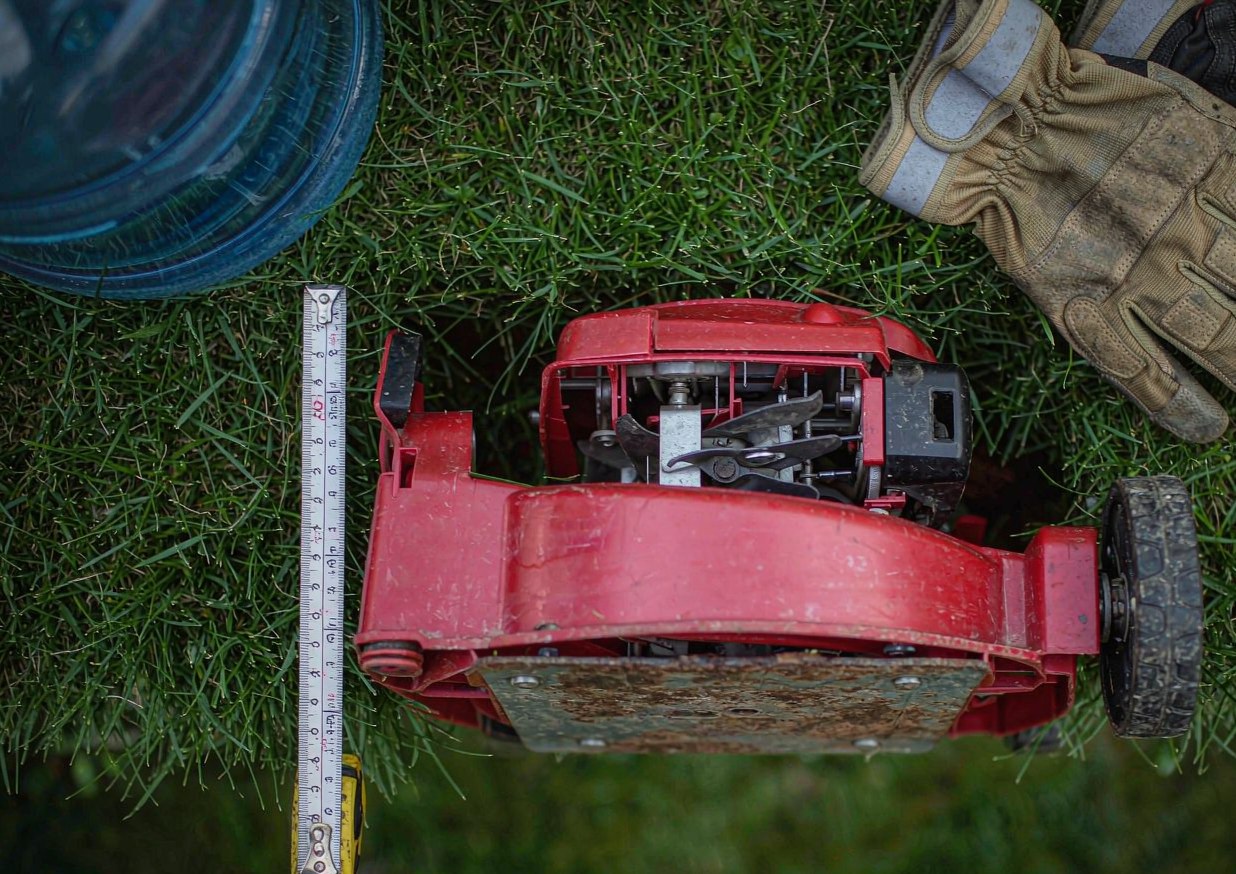
Cool-season grasses (the 2.5 to 4 inch range)
If you grow cool-season grass — tall fescue, Kentucky bluegrass, perennial ryegrass, or fine fescue, the common choices across the northern and transition US — leave it at 2.5 to 4 inches, and err toward the taller end in summer heat. Tall fescue is happiest around 3 to 4 inches; Kentucky bluegrass and ryegrass do well at 2.5 to 3.5; fine fescues can go a touch shorter but still prefer 2.5 to 3. My own lawn is tall fescue and I keep it at about 3.25 inches spring and fall, nudging to 4 inches during July and August heat. The extension guides consistently put cool-season lawns in this band, and stepping outside it downward is where the trouble starts.
The reason cool-season grass wants to be tall is that it does its growing in spring and fall and just tries to survive summer; a taller canopy protects it through the stress season. I used to cut my fescue at 2 inches and wondered why it struggled; the moment I went to 3.25 it stopped. If you are unsure which grass you have, the resources below walk through identification, and matching the height to the species is what makes the rest of this advice actually stick.
Warm-season grasses (the 1 to 2.5 inch range)
Warm-season grasses — Bermuda, zoysia, St. Augustine, centipede, and buffalo — grow on a different playbook and are cut shorter, generally 1 to 2.5 inches, with Bermuda and zoysia on the lower end and St. Augustine toward the upper. These grasses are built for heat and sun, so a shorter cut suits them, but “shorter” is still not “scalped” — even Bermuda should rarely go below about three-quarters of an inch, and St. Augustine can be damaged badly by cutting too low because it grows from above-ground runners. The mistake in warm-season country is usually the opposite of the north: people let it grow shaggy, then scalp it flat in one dramatic pass.
If you are in the southern US, the one-third rule still rules and the height band is just lower. I have friends with Bermuda who keep it at about 1.5 inches and mow two or three times a week in peak summer to honor the one-third rule — that frequency is the trade for the short, tight look. Know your grass, set the band, and mow to the rule; the region changes the number, not the principle.
How to Set Your Mower Height Correctly
Measure from the ground, not the deck
Here is a detail almost everyone gets wrong: the number on your mower deck is not the height of the grass. Deck settings are relative and inconsistent between brands, and the real cutting height is the distance from the ground to the blade, which you should measure directly. The reliable method is to set the deck to your chosen notch, then place the mower on a flat surface, measure from the ground to the bottom of the blade (or to where the grass will be cut), and adjust until the actual height matches your target. I keep a small ruler in the garage and check it once a season, because the “3” on my mower turned out to be closer to 2.25 inches.
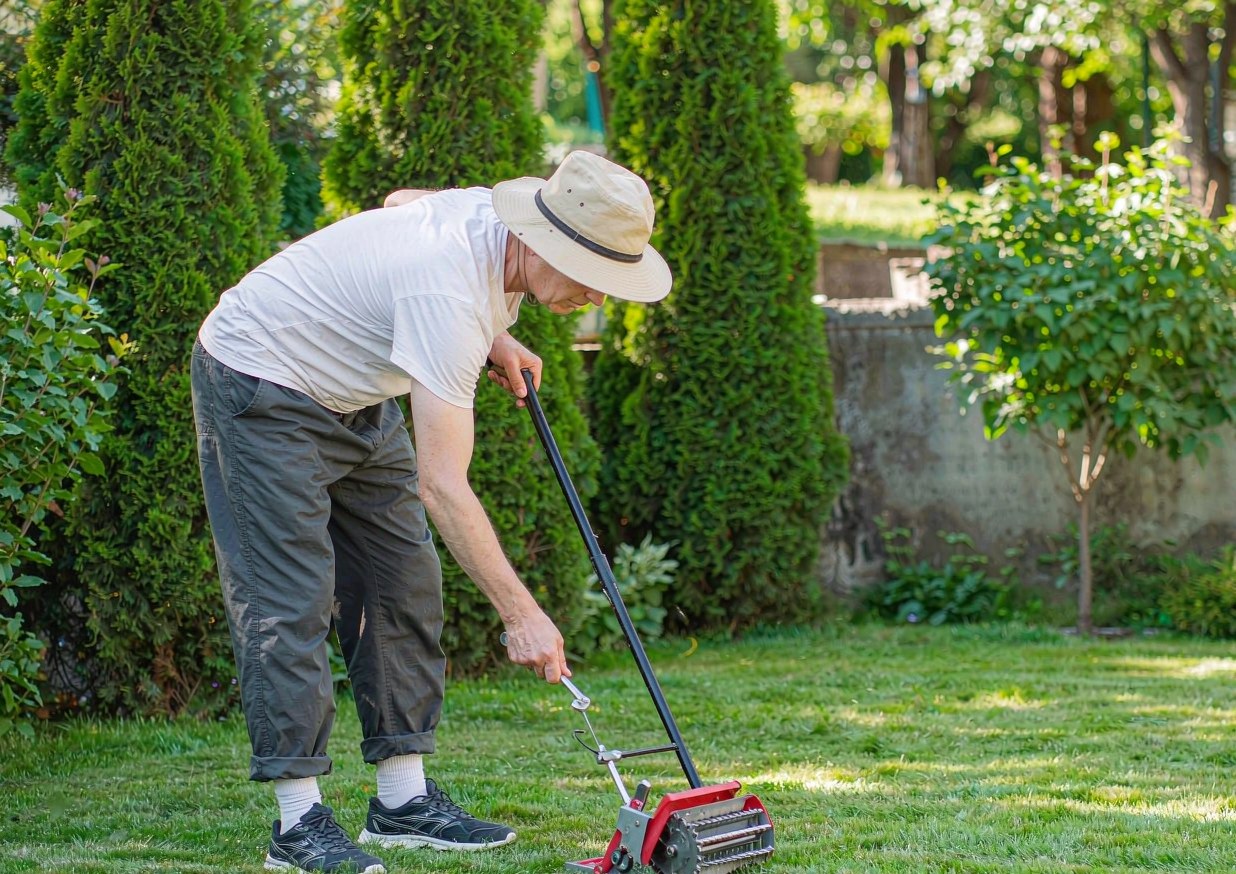
Measuring from the ground also accounts for tire pressure, deck wear, and the fact that the front and rear of a deck often sit at different heights. On a self-propelled mower I once trusted the dashboard notch and scalped the front of every pass because the front wheels sat lower than the rear; measuring showed a half-inch difference I never knew about. Five minutes with a ruler saves a season of striped, brown lawns, and it is the step that turns “I think it’s high enough” into “I know it is.”
Adjust the height through the season
Your ideal height is not a single number for the whole year — it should breathe with the seasons. In the cool, fast-growing spring you can sit at the lower end of your grass’s band; as summer heat arrives, raise the deck by half an inch to an inch to protect the crowns; then in fall you can drop back down as temperatures cool and growth slows. This seasonal nudge is exactly how I stopped my August browning — I raise to about 4 inches in July and August and drop to 3.25 in spring and fall. The grass gets the protection it needs when it is most stressed and the tidiness it wants when it is vigorous.
If you have a mulching mower, the same height rules apply, and raising the deck slightly helps the clippings disperse instead of clumping. Whatever mower you own, the adjustment is usually a lever at each wheel or a single central latch; consult your manual for the exact mechanism, and re-measure after you change it, because notches drift. The point is that the setting is a living choice you revisit a few times a year, not a thing you set once and forget.
Mulching, Bagging, and the Clippings Question
Why leaving clippings is usually best
Once your height is right, the next habit is what you do with the clippings, and the answer for most lawns is: leave them. Grass clippings are about 80 to 90 percent water and break down fast, returning nitrogen and other nutrients to the soil — essentially a free, light fertilizer for the very lawn you just cut. As long as you are following the one-third rule, the clippings are short enough to fall between the blades and disappear within a day or two, feeding the lawn instead of smothering it. I stopped bagging about four years ago and my lawn’s color actually improved while my compost bin stopped filling with grass.
The old fear that clippings cause thatch is mostly a myth; thatch is made of roots and stems, not leaf clippings, and normal mulching does not build it. Leaving clippings also saves the time and mess of bagging and keeps organic matter on the lawn rather than in a landfill. The only time clippings become a problem is when you violate the one-third rule and dump a pile of long cuttings on top — which is yet another reason the height rule comes first. Mulch mowers chop the clippings finer, but even a standard blade leaves little if you mow often enough.
When you should bag instead
There are a few legitimate times to bag. If you let the grass get too tall and the clippings are long enough to mat down and smother the lawn, bag or rake them so they do not block light. If you are clearing a lawn full of leaves in fall, bagging (or mulching the leaves finely) keeps them from smothering the grass over winter. And if your lawn has a disease like fungal blight, bagging and removing clippings can slow its spread — though in that case the real fix is the cultural care in this article, not the bag. I bag maybe twice a year, during the big fall leaf drop, and mulch the rest.
The practical takeaway is that bagging is a tool for specific situations, not the default. Default to mulching, keep the height right so clippings stay short, and your lawn feeds itself. Reaching for the bag every week is extra work that, counterintuitively, makes the lawn need more fertilizer — you are hauling away the very nutrients it wants. Let the clippings lie and the mowing-height habit closes the loop.
Mowing Frequency and Sharp Blades
How often to mow in peak growth
Frequency follows the one-third rule, not the calendar. In cool, wet spring weather, cool-season grass can grow an inch or more a week, which may mean mowing twice weekly to stay within the rule; in the heat-stressed summer, growth slows and once a week or even every ten days may be plenty. Warm-season grasses in summer are the opposite — they grow fast and want frequent cutting to stay in band. The trap is mowing on a fixed “every Saturday” schedule regardless of growth, which guarantees you will sometimes scalp and sometimes let it run long. I mow when the grass hits my trigger height, which lands anywhere from twice a week to every ten days depending on the month.
A neat side effect of mowing high and often: the lawn looks “just mowed” for longer because you are only taking a light top third, and the clippings vanish. My neighbor who scalps once a week has a lawn that looks ragged by day three; mine, cut at the right height twice a week in spring, looks even all week. Frequency tied to growth, not the clock, is what keeps both the height and the look consistent.
The dull-blade problem
The last pillar is a sharp blade, and it is the one people ignore. A dull mower blade does not cut grass — it tears it, leaving ragged, brown-tipped blades that lose moisture and invite disease. You can do everything else right and still get a brown, unhealthy-looking lawn from a dull blade alone. The fix is simple: sharpen or replace the blade a couple of times a season, or whenever the cut ends look frayed instead of clean. I mark my calendar for blade sharpening at the start of spring and again mid-summer, and the difference in lawn color is immediate and obvious.
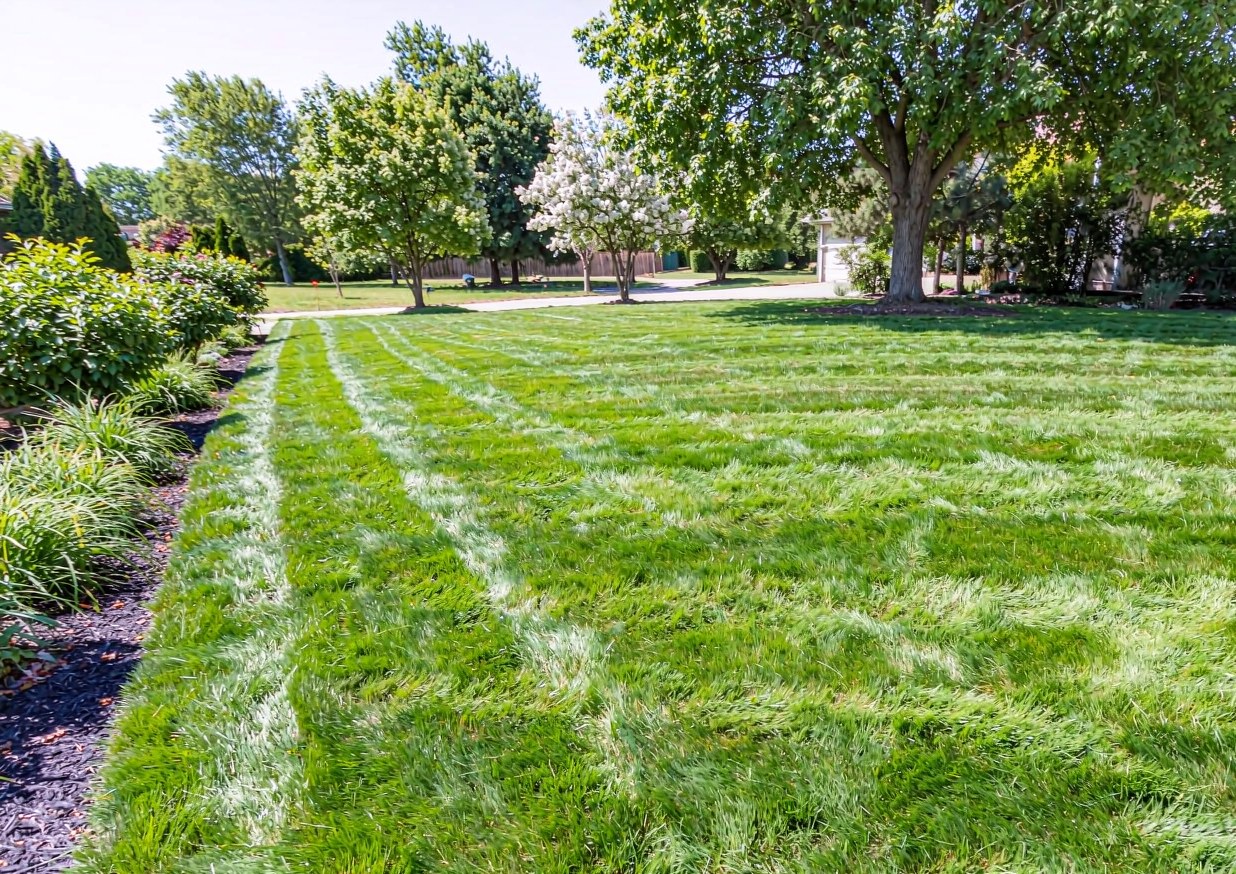
Combine sharp blade with high cut and the one-third rule, and you get the lawn in the photo above — even, green, and resilient — without sprays or constant watering. I cannot overstate how much the blade matters; the year I finally sharpened it monthly, two neighbors asked what I had “treated” the lawn with, and the honest answer was just a sharp blade and a higher deck. Three habits, no chemicals, and the lawn does the work.
Troubleshooting a Lawn That Still Looks Bad After Mowing
Brown tips and torn grass from dull blades
If your lawn looks brown or gray right after mowing, look at the cut ends. Clean cuts show a sharp green tip; torn cuts show a white or brown frayed tip, and a whole lawn of those reads as a brown haze from a few feet away. This is almost always a dull blade, occasionally a mower deck set so low it is bruising the crowns. The remedy is to sharpen the blade and confirm your height with a ground measurement, then the lawn should green up within a few days as new, clean-cut growth appears. I keep a spare sharpened blade so I can swap and mow the same day instead of waiting on a sharpening.
A second cause of post-mow browning is simply cutting too low — scalping — which exposes the lower, older, chlorotic tissue and the soil. If the browning appears as uneven brown patches following your mowing lines, raise the deck immediately and let it recover; water a little extra for a week to reduce stress. The two causes often travel together, because people who scalp usually also neglect the blade, but both are fixed with the same two adjustments: higher deck, sharper blade.
Scalped streaks and an uneven cut
Uneven cutting shows up as stripes of tall grass between stripes of short grass, or as low scalped arcs where the deck dipped. The most common cause is an unlevel deck or mowing over bumpy ground with the deck too low; the blade scalps the high spots while missing the lows. Fix it by raising the overall height (taller grass hides minor bumps), checking that all wheels are on the same setting, and leveling the deck per your manual. On my old uneven lawn, raising to 3.5 inches alone removed most of the scalped streaks because the blade no longer clipped the crowns on the high spots.
If the uneven cut follows your wheel tracks exactly, one wheel may be set lower than the others — a five-minute check with the ruler solves it. And if the lawn is genuinely bumpy, consider a light topdressing or rolling in spring rather than fighting it with the mower. The pattern of the bad cut tells you the cause: lines following wheels means a wheel setting; arcs following dips means deck height vs. terrain; frayed tips means the blade. Read the lawn and the fix is usually one small change.
Troubleshooting Table: Symptoms, Causes and Fixes
| Symptom | Likely cause | Fix |
|---|---|---|
| Brown haze right after mowing | Dull blade tearing blades | Sharpen or replace blade; cut when dry |
| Brown patches following mow lines | Scalping (deck too low) | Raise deck; measure height from ground |
| Stripes of tall and short grass | One wheel set lower than others | Set all wheels equally; level deck |
| Weeds thicker every summer | Grass cut too short, thin canopy | Raise to 2.5-4 in (cool) or 1-2.5 in (warm); follow one-third rule |
| Lawn needs watering constantly | Shallow roots from short mowing | Mow higher; deeper, less frequent watering |
| Clippings mat and smother | Cutting off more than one-third | Mow more often; never remove >1/3; bag once if needed |
FAQs
What height should I set my mower to?
For cool-season grasses (tall fescue, Kentucky bluegrass, ryegrass, fine fescue), set the mower to leave the grass at about 2.5 to 4 inches, taller in summer heat. For warm-season grasses (Bermuda, zoysia, St. Augustine, centipede), aim for about 1 to 2.5 inches, with St. Augustine toward the top of that range. The key is to measure the actual height from the ground rather than trusting the deck number, and to stay within the band for your grass type. When unsure, mow higher — taller grass is almost always healthier than short.
Why does the “short lawn” look feel wrong to most people?
Short feels tidy for a few days, and most mowers ship near their lowest setting, so people never change it. But cutting too short — scalping — removes the leaf the grass needs to make food, exposes soil to sun and weeds, and shallow roots that brown in heat. The “clean” look is short-term; the long-term cost is a stressed, weedy, thirsty lawn. Once you raise the deck, the lawn usually greens up and needs less water and weed control, which is why the higher setting is the one most people get wrong.
How do I follow the one-third rule in practice?
Pick your target height, then mow whenever the grass reaches about one-third taller than that — so at a 3-inch target, mow at roughly 4.5 inches. Mow often enough in fast growth (sometimes twice a week in spring) to stay within that limit, and back off in slow summer. If the grass gets away from you, raise the deck and take it down gradually over a few mows rather than scalping in one pass. The rule protects the plant from shock and is the practical version of “don’t scalp.”
Should I bag my grass clippings?
For most lawns, no — leave them. Short clippings from following the one-third rule fall between the blades, break down quickly, and return nitrogen to the soil, acting as a light free fertilizer. Bag only when clippings are long enough to mat (because you cut too much at once), when clearing fall leaves, or when dealing with a lawn disease you want to remove. The old worry that clippings cause thatch is mostly a myth; normal mulching does not build thatch. Default to mulching and bag for those specific exceptions.
How often should I sharpen my mower blade?
Sharpen or replace the blade about two to three times per season — at minimum at the start of the growing year and again mid-season — or whenever the cut ends look frayed and brown rather than clean and green. A dull blade tears grass instead of cutting it, leaving brown tips and opening the door to disease, and it can make an otherwise well-cared-for lawn look unhealthy. Keeping a spare sharpened blade lets you swap and keep mowing the same day. A sharp blade is as important as the height setting.
Sources and Further Reading
- University of Illinois Extension — Mowing (LawnTalk)
- Oregon State University Extension — Gardening
- North Carolina State University Cooperative Extension
- Michigan State University Extension — Lawn & Garden News
- University of Nebraska-Lincoln Extension
About the author
Samantha has been gardening and arranging her own cut flowers for more than ten years, and has built more than 30 centerpieces from grocery-store bunches, clippings off the cedars behind her house, and a handful of dollar-store experiments that didn’t work. She writes practical, low-cost guides for beginners, including the versions that failed. Prices quoted in her articles are what she actually paid at US grocery and craft stores; nothing is sponsored and no brand pays for a mention. She is not a certified florist, a veterinarian or a horticulturist, and says so wherever a topic touches on plant safety or pet health.
Published: Oct 20, 2026 · Last updated: Oct 20, 2026.
{
“@context”: “https://schema.org”,
“@graph”: [
{
“@type”: “Article”,
“headline”: “How High Should You Mow? The Setting Most People Get Wrong”,
“description”: “Most homeowners mow too short. For cool-season grass cut at 2.5 to 4 inches, for warm-season at 1 to 2.5 inches, never remove more than one-third of the blade, and measure height from the ground. Taller grass grows deeper roots, shades out weeds, and holds moisture.”,
“image”: [
“images/mowing-hero-clean.jpg”,
“images/mowing-materials-clean.jpg”,
“images/mowing-process-clean.jpg”
],
“author”: { “@type”: “Person”, “name”: “Samantha” },
“publisher”: { “@type”: “Organization”, “name”: “gmmur.com” },
“datePublished”: “2026-10-20”,
“dateModified”: “2026-10-20”,
“mainEntityOfPage”: {
“@type”: “WebPage”,
“@id”: “https://gmmur.com/how-high-should-you-mow-setting-most-people-get-wrong”
}
},
{
“@type”: “FAQPage”,
“mainEntity”: [
{
“@type”: “Question”,
“name”: “What height should I set my mower to?”,
“acceptedAnswer”: {
“@type”: “Answer”,
“text”: “For cool-season grasses, leave the grass at about 2.5 to 4 inches, taller in summer heat. For warm-season grasses, aim for about 1 to 2.5 inches, with St. Augustine toward the top of that range. Measure the actual height from the ground rather than trusting the deck number, and stay within the band for your grass type. When unsure, mow higher.”
}
},
{
“@type”: “Question”,
“name”: “Why does the short lawn look feel wrong to most people?”,
“acceptedAnswer”: {
“@type”: “Answer”,
“text”: “Short feels tidy for a few days and most mowers ship near their lowest setting, so people never change it. But cutting too short removes the leaf the grass needs to make food, exposes soil to sun and weeds, and grows shallow roots that brown in heat. The long-term cost is a stressed, weedy, thirsty lawn; raising the deck usually greens it up and cuts water and weed needs.”
}
},
{
“@type”: “Question”,
“name”: “How do I follow the one-third rule in practice?”,
“acceptedAnswer”: {
“@type”: “Answer”,
“text”: “Pick your target height, then mow when the grass reaches about one-third taller than that. Mow often enough in fast growth to stay within that limit and back off in slow summer. If the grass gets away from you, raise the deck and take it down gradually over a few mows rather than scalping in one pass. The rule protects the plant from shock.”
}
},
{
“@type”: “Question”,
“name”: “Should I bag my grass clippings?”,
“acceptedAnswer”: {
“@type”: “Answer”,
“text”: “For most lawns, leave them. Short clippings from following the one-third rule fall between the blades, break down quickly, and return nitrogen to the soil as a light free fertilizer. Bag only when clippings are long enough to mat, when clearing fall leaves, or when dealing with a lawn disease. The worry that clippings cause thatch is mostly a myth.”
}
},
{
“@type”: “Question”,
“name”: “How often should I sharpen my mower blade?”,
“acceptedAnswer”: {
“@type”: “Answer”,
“text”: “Sharpen or replace the blade about two to three times per season, or whenever the cut ends look frayed and brown rather than clean and green. A dull blade tears grass instead of cutting it, leaving brown tips and opening the door to disease. Keeping a spare sharpened blade lets you swap and keep mowing the same day. A sharp blade is as important as the height setting.”
}
}
]
}
]
}