
If you’re putting together a Christmas centerpiece this year, the pairing of red flowers and green foliage is the one I’d recommend before anything else. Every December I set a red and green Christmas flower arrangement on the living room table, and that single piece lifts the whole house into holiday mode in about five minutes. But if you’re a beginner, you’re probably stuck exactly where I was: where do I even start? The first one I made came out lopsided and cluttered, and I nearly gave up on the whole idea. Once you know the basics, though — how to choose the container, how to choose your materials, and which plants are safe to have on a table where people eat and pets wander — anyone can build something that looks bought. In this article I’ll walk you through the exact steps I use now, including the mistakes. Ready? Let’s go through it together.
Quick answer: three things decide whether a red and green Christmas centerpiece looks professional. First, pick a container under 12 inches tall for a dining table so guests can still see each other across it. Second, build the greenery framework from cedar, fir or pine first, then add red flowers in odd-numbered clusters at a 60:40 red-to-green ratio. Third, change the water daily and re-cut about an inch off each stem at an angle. Do those three and a $20 grocery-store arrangement holds up for a week to ten days instead of three. Everything below explains why.
- 1. Making a Red and Green Christmas Centerpiece
- 2. Choosing Your Materials and Comparing Costs
- 3. Free Materials From Your Yard or Garden
- 4. A Centerpiece Built Around Potted Plants
- 5. Design Techniques for Combining Red and Green
- 6. Common Beginner Mistakes to Avoid
- 7. Styling the Table Around It
- 8. A Checklist for Avoiding Problems
- 9. Ideas That Stretch Your Budget Further
- 10. Eco-Friendly Arrangements
- 11. Using the Same Ideas Beyond December
- 12. Troubleshooting: Symptoms, Causes and Fixes
- 13. FAQs
- 14. Sources and Further Reading
Making a Red and Green Christmas Centerpiece
Why does the red and green pairing work so well?
Once the Christmas season gets close, you want to decorate every surface in the house, right? A Christmas centerpiece built from red flowers and green foliage gets you there faster than anything else — and there’s real reasoning behind why. In color psychology, red reads as warmth, energy and celebration, while green reads as nature, calm and stability. Stand them next to each other and you create a contrast the eye locks onto immediately.
I set a Christmas flower arrangement on the living room table every year, and I’m convinced it’s the best spot in the house for one, because it’s exactly where family and guests end up standing. Red and green together brighten a whole room. That said, I understand why beginners find it intimidating — my first attempt had the balance completely wrong and looked like a pile rather than a design. A handful of basics fixed it. Adjust the height of your stems and the placement of your colors and suddenly it looks like a florist made it. Even though it may feel like a lot at first, these five tips will carry you through.
Start with the container
When you’re choosing a container, a tall vase gives you drama, but a low vessel won’t block anyone’s face across the table. For a small table, I always recommend a low glass bowl.
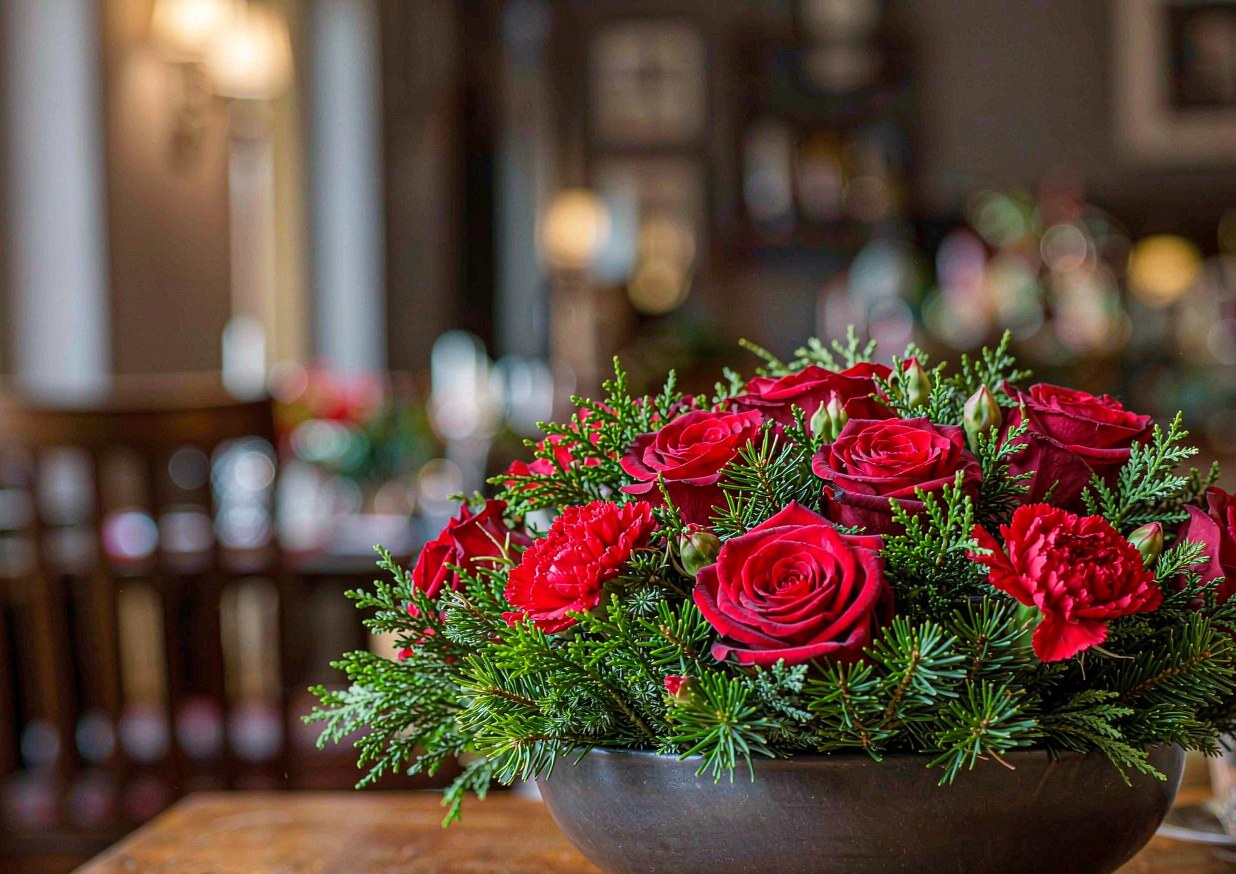
So how do you actually choose? Tall vases earn their keep on a console table, a mantel, or in the entryway — anywhere nobody needs to see over them. On the dining table, though, pick a low vase or a shallow bowl so guests can still talk to each other. One year I used a ceramic bowl roughly 6 inches tall for my Christmas flower arrangement, arranged red roses and green cedar through the middle, and scattered a few small candles around the base. It read as warm and deliberate, and it cost me almost nothing extra. Material matters too: glass looks clean and modern, ceramic looks natural, and a thrifted brass dish looks vintage. Match it to the room you’re decorating and you’ll never feel off.
Choosing Your Materials and Comparing Costs
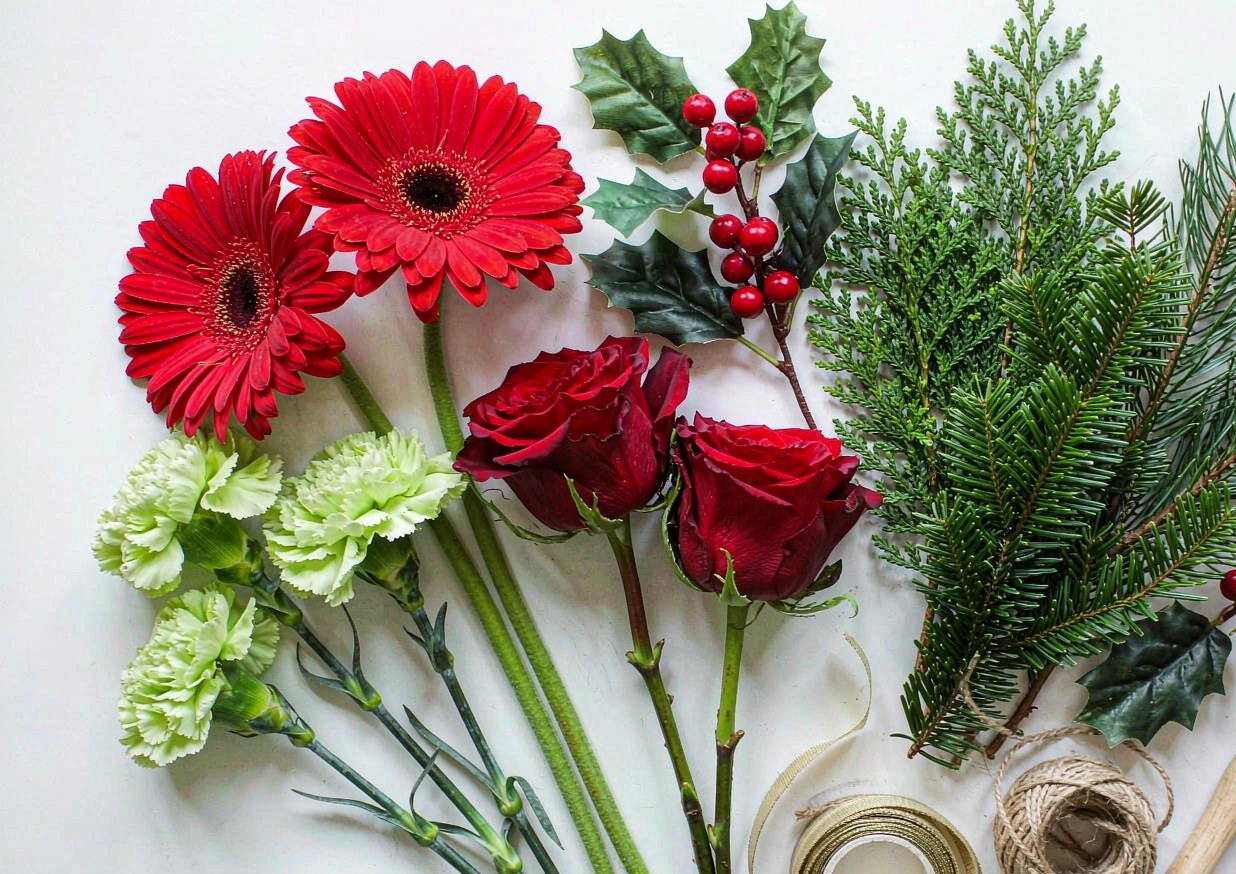
Everything I build starts from the same short kit. None of it is specialist equipment, and most of it is reusable for years:
- A low ceramic bowl or glass vase — wide enough that the arrangement won’t tip
- Floral snips or garden pruners — scissors crush stems and shorten vase life
- Chicken wire or a floral frog — holds stems upright without floral foam
- A waterproof liner — protects wood finishes from leaks
- Felt furniture pads — stop the base scratching the table
- LED candles — the flame-free version of the candle look
- Wired gold ribbon — ties the container to the rest of the table
 Photos provided by Pixabay
Fresh or faux: which should you choose?
Fresh flowers are easy to find even in December, but the cost climbs quickly. Budget-friendly picks like a bunch of red gerbera daisies or a bundle of green carnations usually run $8 to $15 at a grocery store.
Here’s a question for you: would you rather buy fresh flowers or faux stems? My answer these days is both. Faux stems have one big advantage — you can reuse them every year — which makes them the better value over three or four Christmases. But the natural scent and softness of fresh flowers is exactly what silk can’t reproduce. The best Christmas flower arrangement I saw last December was at a friend’s house: fresh roses mixed with faux holly branches. It was realistic where it needed to be and tough everywhere else, and she’d spent about $22. That hybrid approach lets you scale everything to whatever your budget looks like this month, so give it a try.
Comparing the cost of fresh and faux
The table below lines up the main differences between fresh flowers and faux flowers. Prices reflect typical US retail listings at grocery stores and craft chains — your local store will vary.
| Item | Fresh flowers | Faux flowers |
|---|---|---|
| Upfront cost | $25–$40 per arrangement | $10–$18 per arrangement |
| Lifespan | About 1–2 weeks | Several years (depends on storage) |
| Maintenance | Water changes and re-trimming | Almost none (occasional dusting) |
| Realism | Very high | Moderate (premium faux looks real) |
As you can see, fresh flowers carry a higher upfront cost, but they’re the right call if you want real beauty and real scent sitting on your table. Faux flowers win on cost per year, which suits anyone who wants the same design every December without rebuilding it from scratch. Most of the time I mix them: a base of faux greenery with a few fresh red blooms dropped in as focal points. You get the impact of fresh flowers at roughly half the cost. Try a couple of combinations and see which balance feels right for your budget.
Free Materials From Your Yard or Garden
How to use evergreen clippings
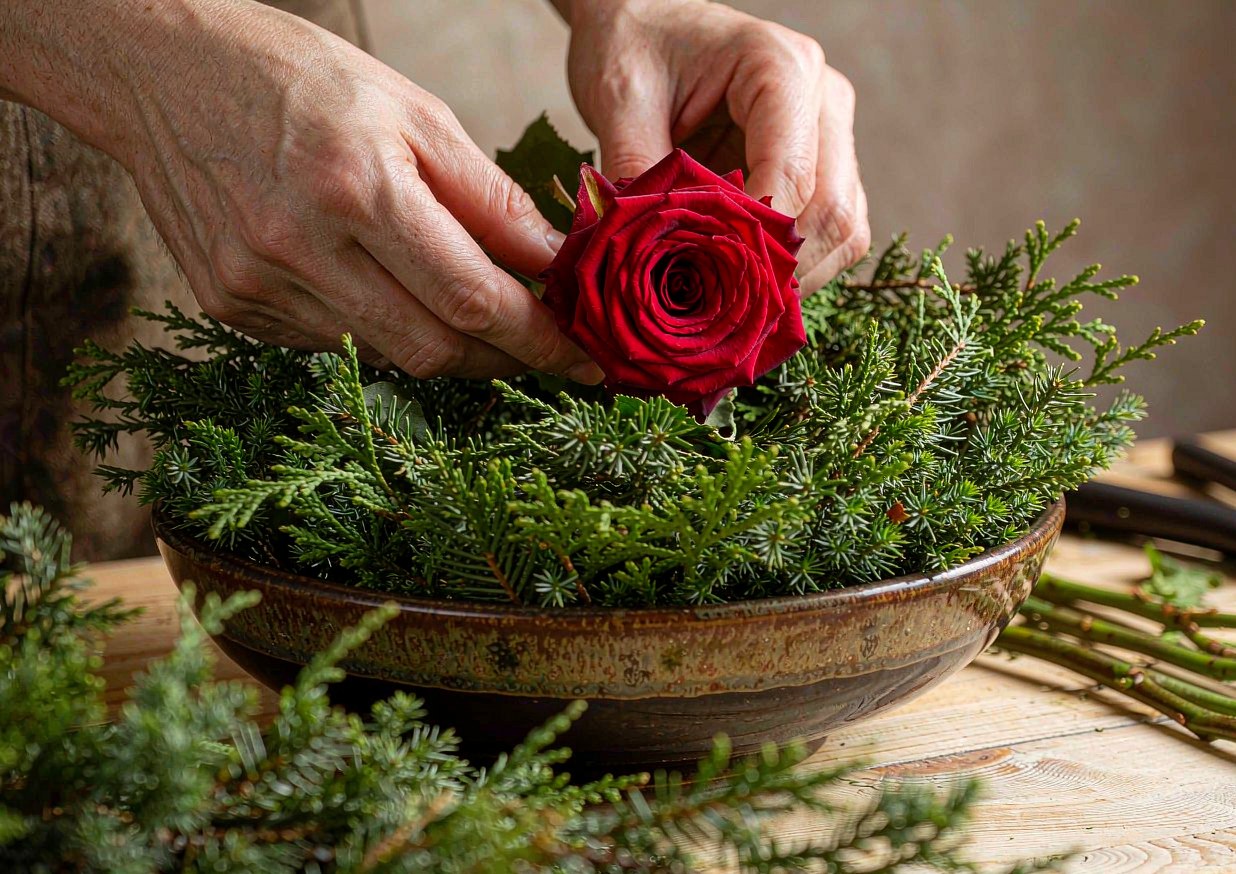
If you have evergreens in your yard, you already own half of your centerpiece. Trimmings from arborvitae, fir, pine or cedar are exactly the natural material a Christmas centerpiece wants.
The one thing I check before cutting anything is toxicity. Yew is gorgeous — those red berries look made for Christmas — and it’s genuinely dangerous to dogs, cats and horses. A friend of mine worked yew branches into a Christmas flower arrangement and then spent a panicked hour on Google after her retriever started chewing a sprig. Always confirm the species first: I check the ASPCA toxic and non-toxic plant list before anything new comes indoors. For my own arrangements I mostly use cedar, fir and pine, which look right, smell right and aren’t an issue for pets. Trim with clean pruners, cut the ends at an angle, and strip every needle that would sit below the waterline so the water stays clean.
 Photos provided by Pixabay
Winter flowers that are actually affordable
The most dependable fresh flowers in December are plain old mums and carnations. Both come in plenty of red and green varieties, and both are cheap enough to fill a whole arrangement for well under $20.
I once built an entire Christmas flower arrangement around red mums, and I keep going back to them because they last — a solid two weeks on the table, which is what makes them so cost-effective. Carnations are my wildcard: a green variety like ‘Green Trick’ shifts the entire look of an arrangement, because nobody expects green petals in December. I mixed green and red carnations into a Christmas centerpiece one year and had two separate guests ask which florist I’d ordered it from. Grab a bunch of each, aim for a cluster of odd numbers, and you’ll spend less than a pre-made bouquet while getting something that looks like twice the price.
A Centerpiece Built Around Potted Plants
Why amaryllis and poinsettias steal the show
Potted plants have one big advantage over cut stems: they keep going for weeks. Amaryllis and poinsettia in particular are naturals as the focal point of a Christmas centerpiece.
So how do you work a potted plant into a Christmas flower arrangement? An amaryllis is force-bloomed to flower in midwinter, so you get those enormous red trumpets right when you want them. I’ve set a red amaryllis dead center in a centerpiece and ringed it with green cedar clippings, and the effect was immediate — guests notice it the moment they walk in. A poinsettia gives you red bracts (the colored leaves people mistake for petals) at a fraction of the price, but check your pets first: poinsettia sap is mildly toxic and can irritate a cat’s mouth and stomach, and a friend of mine ended up at the vet after hers took a bite. Read up on each plant before it goes on the table, and you can enjoy it for the whole season.
Care tips for potted plants
Using potted plants in your Christmas centerpiece should mean less work, not more — but watering and light still matter.
Whenever I use a potted amaryllis in an arrangement, I put it somewhere genuinely bright, because amaryllis simply won’t open without enough light, and the stalk will flop toward the window. A poinsettia, on the other hand, hates drying out, so the rule is to water once the top inch of soil feels dry — and never let the pot sit in a puddle. One friend overwatered hers as a centerpiece and rotted the roots in about ten days. Before anything goes on your table, check the basics: does it want bright light, how often does it want water, and does the pot have drainage? Slip the grow pot into a saucer or a decorative cachepot so moisture never reaches your wood finish. If you want the specifics for a particular species, the Missouri Botanical Garden Plant Finder has care sheets for nearly every holiday plant. Keep them happy and that centerpiece will outlast every cut flower on the table.
Design Techniques for Combining Red and Green
 Photos provided by Pixabay
Getting the ratio right
When you combine red flowers and greenery, the decisive factor is balance. Too much of either and the arrangement looks busy; too little and it reads flat and forgettable.
Here’s a second question for you: how do you decide the ratio of red to green in your Christmas flower arrangement? The ratio I recommend is 60:40, red to green. That split lets the warmth of the red lead while the green settles everything down. For my first Christmas centerpiece I went roughly 70% red roses to 30% cedar, and it came out a little too loud — visually it shouted across the room. I pulled two roses and added another cedar branch, and the whole thing calmed down instantly. Also worth knowing: flowers arranged in odd numbers (3, 5, 7) look more natural than even clusters. Play with those two levers and you’ll land on a version that feels like yours.
Playing with height and placement
In any Christmas centerpiece, stem height does as much work as color. Put taller stems toward the back and shorter ones in front and you create depth instead of a flat wall of flowers.
Most years I set a tall amaryllis at the back of the centerpiece and layer red carnations and green cedar in front of it. That staggered arrangement produces a natural sense of depth that reads like professional floral design, which is exactly what happened the year a friend asked me where I’d bought it. A couple of practical rules help here: build the greenery framework first, add your focal flowers second, and step back every few stems to look at it from across the room — not from two inches away. Get the height and placement right and you can make something genuinely eye-catching out of $20 worth of grocery-store flowers.
Common Beginner Mistakes to Avoid
Getting toxic plants wrong
Before you build anything, look up the toxicity of every plant you’re planning to use. In a house with pets or small children, this isn’t optional.
I avoid anything questionable in a centerpiece that sits where people eat. Holly berries, mistletoe and yew are all Christmas classics and all problematic if chewed; even poinsettia, which is only mildly toxic, is not something I want a cat sampling. A friend of mine decorated with poinsettias one year and her dog chewed the leaves off the lower branches, which meant an emergency vet visit and a bill she still complains about. Check any new plant against the ASPCA plant database before it comes inside. Reliable, pet-safe options I use constantly: roses, carnations, mums, snapdragons, cedar, fir and pine. Choose from that list and you can put safety first without giving up a single bit of the look.
One boundary worth stating plainly: this article is general decorating information, not veterinary advice. I’m not a vet, and no plant list — including the ASPCA database — is exhaustive. If you think a pet or a child has actually eaten something questionable, call your vet or the ASPCA Animal Poison Control Center at (888) 426-4435 rather than waiting to see what happens.
Crowding the stems
The most common mistake in a Christmas flower arrangement is packing the stems too tightly. Crowding blocks airflow between blooms and shortens vase life noticeably.
When I build a Christmas centerpiece, I deliberately leave a little air between stems. That gap improves air circulation and extends how long the flowers last. My very first arrangement had everything jammed shoulder to shoulder, and it wilted in three days — I couldn’t work out what I’d done wrong. Now that I space things properly, I get a solid week to ten days out of the same flowers. If you skip too much space, the arrangement can also look sparse, so aim for stems that touch but aren’t crushed. Watch that spacing and rather than rebuilding it every few days, you’ll get a centerpiece that looks good for the whole run-up to Christmas.
Styling the Table Around It
Pairing candles and ribbon
Once your Christmas centerpiece is sitting in the middle of the table, adding candles or ribbon multiplies the impact.
I nearly always wind gold ribbon around the container or scatter a few small candles at the base of my red and green arrangement. The combination creates a warm, welcoming atmosphere that’s perfect for having people over, and when I added candles to a Christmas flower arrangement for the first time the whole room shifted into something softer and more romantic. Just be careful with open flame: keep candles at least 12 inches from greenery, never leave them burning unattended, and consider LED candles instead — battery-powered ones last for dozens of evenings and remove the risk completely. The NFPA candle safety guidance is worth a skim before you light anything next to dried material. Add ribbon or candles and enjoy a table that feels genuinely special.
Matching the centerpiece to your table
The size of your Christmas centerpiece should follow the size of your table. Too large and people are eating around it; too small and there’s no point.
On my dining table I keep anything I build under about 12 inches tall, which keeps sightlines clear so guests can talk without leaning sideways. In the living room I’ll go taller — 16 to 18 inches on a coffee table or console reads as a real focal point from across the room. A friend once put a 20-inch arrangement on her dining table and everyone spent dinner leaning around it, so learn from that one. There’s a simple rule of thumb that works well too: the arrangement shouldn’t take up more than about a third of the table’s width, or there’s nowhere left for the platters. Scale it to your table and you’ll get the impact without the inconvenience.
A Checklist for Avoiding Problems
Safety checks before you set it down
Before a Christmas centerpiece goes onto any table, confirm the safety basics. In a home with pets or children, this step matters more than the design does.
I run through a mental checklist every year, and here it is. First, look up the toxicity of every plant and berry in the arrangement. Second, check that the container is stable — wide base,weighted if it’s tall, and definitely not something that tips when someone bumps the table. Third, if you’re using candles, keep flames out of reach of anything dry and never leave the room with them lit. Follow those three and you’ll have a completely safe Christmas flower arrangement. I’ve been using this checklist for years and haven’t had a single incident since. Even beyond safety, it’s worth checking two more things first: does the container leak, and will it scratch the finish? Felt pads under the base solve the second one in seconds.
Storing your materials so they last
If you want a Christmas flower arrangement to last, how you store and maintain it matters as much as how you build it. Change the water on fresh stems and dust the faux ones, and everything stays looking good.
To keep a fresh centerpiece going, I change the water every morning and re-cut about an inch off each stem at an angle while I’m at it. That one minute of effort roughly doubles the vase life. It also helps to keep the arrangement away from direct sun, heating vents and fruit bowls — ethylene from ripening fruit ages flowers fast. For faux arrangements, storage is about keeping dust and damp off: I keep mine in a sealed plastic bin in a closet, out of direct sunlight, and they come out looking new the following November. Handle storage right and you won’t need to rebuild your Christmas centerpiece from scratch every year.
Ideas That Stretch Your Budget Further
Making the most of dollar-store supplies
If you’re watching your budget, dollar-store stems are genuinely useful. A single faux rose or holly sprig costs about $1.25 at Dollar Tree.
Why bother with them? Because dollar-store supplies are consistent and available in volume, and you’re not precious about experimenting with a stem that cost a dollar. I once built a whole Christmas centerpiece from five faux red roses and three holly sprigs for right around $10, and it looked far more expensive than it was. Do check quality in person, though: anything with hard, glossy plastic petals reads as cheap immediately, so look for fabric petals and wired stems you can bend into shape. Two upgrades take it further — separate and tease the petals apart so they don’t sit flat, and trim stems with wire cutters rather than scissors. Give the dollar store a try and the cost per arrangement drops dramatically.
Dried vs. preserved flowers: a comparison
If longevity is what you’re after, dried flowers and preserved flowers both belong on your list. Depending on the type, they’ll hold up for months or even years.
The table below compares the two. Figures reflect typical US craft-store and online florist listings.
| Item | Dried flowers | Preserved flowers |
|---|---|---|
| Price per stem | $2–$4 | $5–$9 |
| Lifespan | Around 6 months–1 year | Around 1–3 years |
| Feel | Brittle, crumbles easily | Soft, closer to fresh |
| Color | Fades gradually | Holds color well |
As the table shows, dried flowers are much cheaper, but they’re fragile to handle. I once built a centerpiece around dried eucalyptus and it shed and crumbled every time someone brushed past the table — I regretted it within a week. Preserved flowers cost noticeably more, yet they keep their color and shape for years and feel closer to the real thing. If you skip the cheap end entirely, you’ll spend more upfront; if you go all-dried, you’ll be vacuuming by New Year. Pick based on where the arrangement sits and how long you want it to last.
Eco-Friendly Arrangements
Turning recycled items into containers
If you want a genuinely sustainable Christmas centerpiece, start with the container and use something you already have. Clean tin cans, glass jars and thrifted bowls all work.
Have you ever looked at something on its way to the recycling bin and thought it could hold flowers? I painted a couple of empty jars with acrylic paint — simple red and green stripes — and turned them into containers for a Christmas flower arrangement. The whole project took about 30 minutes and cost nothing. Two cautions, though: slide a glass jar or waterproof liner inside anything porous, and check stability before you commit, since lightweight cans tip easily. I put a handful of small stones in the bottom for ballast and it stopped moving entirely. Raid the thrift store too — vases and brass dishes cost a dollar or two and nobody can tell. Start with recycled containers and you’ll end up with something genuinely original.
Growing your own cut flowers
If you want the most sustainable option there is, grow the flowers yourself. Hellebores (often sold as Christmas rose) and cyclamen both flower in winter.
I grew a cyclamen in a pot one year specifically to use in a Christmas flower arrangement, and it turned out to be ideal: red or pink flowers sitting above green patterned leaves, which is the Christmas palette without any dye or wire. It does take planning, though — you buy it as a plant in autumn, around $6, and it starts flowering by November. Starting from seed is a genuinely long game, so buying a young plant is the practical route. One caution with hellebores specifically: they’re toxic if ingested, so keep them out of reach of pets and treat them as a garden flower rather than a table plant. Grow your own and you get a sustainable centerpiece that costs a couple of dollars a year.
Using the Same Ideas Beyond December
Pastel spring arrangements
Everything above applies just as well outside December. Swap in pink and yellow flowers and you have a soft spring centerpiece using exactly the same techniques.
Why does it transfer so cleanly? Because color balance and height placement aren’t seasonal rules — they’re design rules. One spring I combined pink tulips with white sweet peas and tried the same 60:40 ratio I use at Christmas, and it came out balanced and calm in the same way. There’s one adjustment worth making, though: spring stems are far softer than winter ones, so handle them gently when you arrange them. I also cut the ends at an angle so they drink properly, and tulips appreciate being stood in cool water for an hour before arranging. Take these Christmas techniques into spring and you’ll get far more use out of one set of skills.
Orange and brown for fall
For fall, build around orange and brown. Orange gerbera daisies and cosmos with brown dried material gives you a warm autumn table with no Christmas reference at all.
Last October I put together an autumn version of the same arrangement using orange gerberas and brown dried stems, and swapping red and green for orange and brown changed the entire mood of the table. The brown dried material in particular does the heavy lifting — it grounds everything and makes it feel seasonal rather than random. The catch, again, is that dried material is brittle, so handle it gently and expect a little shedding. I usually place the dried stems at the center of the arrangement where nothing brushes them and put the fresh gerberas around the outside. Change the palette by season and essentially you’ll have one flower-arranging method that covers the whole year.
Troubleshooting: Symptoms, Causes and Fixes
Most centerpiece problems show up within two days, and nearly all of them trace back to one of six causes. This is the table I wish I’d had when I started.
| Symptom | Likely cause | Fix |
|---|---|---|
| Flowers wilt within 2–3 days | Stems crowded; water never changed | Leave air between stems, change water daily, re-cut 1 in at an angle |
| Arrangement looks flat from across the room | Every stem cut to the same height | Tall stems at the back, short at the front, then step back and check |
| Needles shedding onto the table | Foliage left below the waterline, or heat from a vent | Strip everything below the waterline; keep it away from vents and sun |
| Guests can’t see each other over it | Container taller than 12 in on the dining table | Rebuild in a bowl under 12 in, or move it to a mantel or console |
| Greenery browning at the tips | Sitting too close to a candle flame | Keep 12 in of clearance, or switch to LED candles |
| The red reads too loud | Red-to-green ratio above 70:30 | Pull two red stems and add one more green branch to reach 60:40 |
FAQs
Why is a red and green Christmas centerpiece so popular?
Color psychology and Christmas tradition are tangled up together here. Red reads as warmth, energy and celebration; green reads as nature, calm and stability. That contrast is what creates the instant visual pop, and it’s why the combination feels festive even in a sparsely decorated room. I set out red roses and green cedar on the living room table every year, and guests almost always comment on it. My practical advice is to aim for a 60:40 ratio of red to green: heavy enough on red to feel celebratory, heavy enough on green to stay grounded. If you’re doing this for the first time, build your greenery framework first, then add your red flowers in clusters of three or five — it pulls together much faster than placing flowers one at a time.
Fresh or faux? I want to keep costs down.
Mixing the two gives you the best cost-per-wear, and it’s what I do now. In my experience fresh flowers run $25 to $40 per arrangement while a comparable faux version costs $10 to $18 — but faux stems can’t give you real scent, and scent is most of the atmosphere. So I use a faux greenery base and buy fresh flowers only as focal points. Concretely: a base of faux cedar or holly sprigs plus three fresh red gerberas gets you roughly $20 total and about ten days on the table. The faux base is reused next year, which makes year two dramatically cheaper. If your budget is really tight, start with all-faux and add one bunch of fresh flowers — you can always upgrade later.
What kind of container should I use for a Christmas centerpiece?
It depends entirely on the table. My rule is that height follows location: for a dining table, choose something under 12 inches tall, like a wide ceramic bowl, so nobody has to peer around it during dinner. For a mantel, console or entryway, where nobody sits opposite the arrangement, you can go 16 to 18 inches and get real drama. Material sets the mood too — glass reads modern and clean, ceramic reads warm and natural, thrifted metal or brass reads vintage. My own default is a low ceramic or glass bowl roughly 6 inches tall, filled with red roses and green cedar, with a few candles set around the base. One practical note before you commit: check that it’s watertight, and add felt pads underneath to protect the finish.
Can I use clippings from my yard, and is there anything I should watch out for?
Yes, and it’s the cheapest material you’ll find — but check toxicity first. Arborvitae, fir, pine and cedar trimmings are safe, smell right and hold well indoors. The one to avoid is yew: those red berries look perfect for Christmas, and the plant is genuinely toxic to dogs, cats and horses. A friend of mine used yew in a table arrangement and then spent a panicked evening at the vet, so please don’t learn that lesson the hard way. Holly berries and mistletoe deserve the same caution around pets and small children. Before anything new comes inside, I check it against the ASPCA’s toxic and non-toxic plant list, then trim with clean pruners, cut the ends at an angle, and strip any foliage that would sit below the waterline. To be clear, that’s general decorating information and not veterinary advice — if your pet actually eats something, call your vet or the ASPCA Poison Control hotline at (888) 426-4435.
Any tips for making a Christmas centerpiece last longer?
Daily water changes and re-trimming the stems are what actually move the needle. Every morning I change the water and cut about an inch off each stem at an angle; that single habit roughly doubles vase life, which means mums and carnations last close to two weeks rather than a few days. The second thing is spacing — don’t crowd the stems. Leaving air between blooms improves circulation and slows wilting, whereas my first tightly packed arrangement collapsed in three days. Finally, watch the location: keep it out of direct sunlight, away from heating vents and drafts, and away from any fruit bowl, since ripening fruit releases ethylene that ages flowers quickly. Do those three things and your centerpiece should hold up for the whole season.
Sources and Further Reading
- ASPCA — Toxic and Non-Toxic Plants List
- ASPCA — Animal Poison Control
- NFPA — Candle Fire Safety
- NFPA — Home Fire Safety
- Missouri Botanical Garden — Plant Finder
About the author
Samantha has been gardening and arranging her own cut flowers for more than ten years, and has built more than 30 centerpieces from grocery-store bunches, clippings off the cedars behind her house, and a handful of dollar-store experiments that didn’t work. She writes practical, low-cost guides for beginners, including the versions that failed. Prices quoted in her articles are what she actually paid at US grocery and craft stores; nothing is sponsored and no brand pays for a mention. She is not a certified florist, a veterinarian or a horticulturist, and says so wherever a topic touches on plant safety or pet health.
Published: Oct 17, 2026 · Last updated: Oct 18, 2026.
{
“@context”: “https://schema.org”,
“@graph”: [
{
“@type”: “Article”,
“headline”: “Red and Green Christmas Centerpiece: 5 Easy Tips Any Beginner Can Master”,
“description”: “Three things decide whether a red and green Christmas centerpiece looks professional: container height, a 60:40 red-to-green ratio, and daily water changes with angled stem cuts.”,
“image”: [
“https://gmmur.com/wp-content/uploads/sites/5/2026/10/centerpiece-hero-clean-1.jpg”,
“https://gmmur.com/wp-content/uploads/sites/5/2026/10/centerpiece-materials-clean-1.jpg”,
“https://gmmur.com/wp-content/uploads/sites/5/2026/10/centerpiece-process-clean-1.jpg”
],
“author”: { “@type”: “Person”, “name”: “Samantha” },
“publisher”: { “@type”: “Organization”, “name”: “REPLACE_WITH_SITE_NAME” },
“datePublished”: “2026-10-17”,
“dateModified”: “2026-10-18”,
“mainEntityOfPage”: {
“@type”: “WebPage”,
“@id”: “https://REPLACE_WITH_DOMAIN/red-and-green-christmas-centerpiece-beginner-tips”
}
},
{
“@type”: “FAQPage”,
“mainEntity”: [
{
“@type”: “Question”,
“name”: “Why is a red and green Christmas centerpiece so popular?”,
“acceptedAnswer”: {
“@type”: “Answer”,
“text”: “Color psychology and Christmas tradition are tangled up together here. Red reads as warmth, energy and celebration; green reads as nature, calm and stability. That contrast creates the instant visual pop. Aim for a 60:40 ratio of red to green, build the greenery framework first, then add red flowers in clusters of three or five.”
}
},
{
“@type”: “Question”,
“name”: “Fresh or faux? I want to keep costs down.”,
“acceptedAnswer”: {
“@type”: “Answer”,
“text”: “Mixing the two gives the best cost per wear. Fresh flowers run $25 to $40 per arrangement while a comparable faux version costs $10 to $18, but faux stems can’t give you real scent. Use a faux greenery base and buy fresh flowers only as focal points: faux cedar plus three fresh red gerberas is roughly $20 total and lasts about ten days.”
}
},
{
“@type”: “Question”,
“name”: “What kind of container should I use for a Christmas centerpiece?”,
“acceptedAnswer”: {
“@type”: “Answer”,
“text”: “Height follows location. For a dining table, choose something under 12 inches tall, like a wide ceramic bowl, so nobody has to peer around it. For a mantel, console or entryway, 16 to 18 inches gives real drama. Check that the container is watertight and add felt pads underneath to protect the finish.”
}
},
{
“@type”: “Question”,
“name”: “Can I use clippings from my yard, and is there anything I should watch out for?”,
“acceptedAnswer”: {
“@type”: “Answer”,
“text”: “Yes, and it is the cheapest material you will find, but check toxicity first. Arborvitae, fir, pine and cedar trimmings are safe and hold well indoors. Avoid yew, holly berries and mistletoe around pets and small children. Trim with clean pruners, cut the ends at an angle, and strip foliage that would sit below the waterline. This is general information, not veterinary advice: if your pet eats something, call your vet or the ASPCA Poison Control hotline at (888) 426-4435.”
}
},
{
“@type”: “Question”,
“name”: “Any tips for making a Christmas centerpiece last longer?”,
“acceptedAnswer”: {
“@type”: “Answer”,
“text”: “Change the water every morning and re-cut about an inch off each stem at an angle; that habit roughly doubles vase life. Do not crowd the stems, since air circulation slows wilting. Keep the arrangement out of direct sunlight, away from heating vents and drafts, and away from fruit bowls, because ripening fruit releases ethylene that ages flowers quickly.”
}
}
]
}
]
}