
The first time a tomato hornworm found my garden, I lost an entire plant in about four days and never saw the culprit. I walked out one morning to a tomato vine that looked like someone had taken scissors to every leaf, with a few half-eaten green tomatoes dangling on bare stems. I assumed it was a disease. It was a single fat green caterpillar I had walked past three times without noticing, because it was the exact color of the leaf it was lying on. If you grow tomatoes, this will happen to you eventually, and the good news is that hornworms are some of the easiest pests to deal with by hand — once you know how to actually find them. In this article I walk through the exact routine I use now, including the year I almost gave up on tomatoes entirely.
Quick answer: a tomato hornworm is a large green caterpillar (with white diagonal stripes and a harmless horn on its rear) that can strip a tomato plant in days. You do not need spray. The method that works is finding them by looking for chewed leaves, black droppings (frass), and missing fruit, then hand-picking them off and dropping them into a bucket of soapy water. Check plants every two to three days in summer, especially the tops and the leaf undersides. Leave any hornworm covered in white cocoons alone — those are parasitic wasps finishing the job for you.
- 1. Meet the Tomato Hornworm
- 2. How to Actually Find Them
- 3. Hand-Picking: The Method That Works
- 4. What to Do With the Ones You Collect
- 5. The Braconid Wasp Trick (Leave Some Alone)
- 6. Prevention for Next Season
- 7. Common Mistakes
- 8. Companion Planting and Habits That Help
- 9. The Lifecycle, So You Can Time It
- 10. Hornworms vs. Other Tomato Leaf-Eaters
- 11. A Note on Sprays and When to Skip Them
- 12. Troubleshooting: Symptoms, Causes and Fixes
- 13. FAQs
- 14. Sources and Further Reading
Meet the Tomato Hornworm
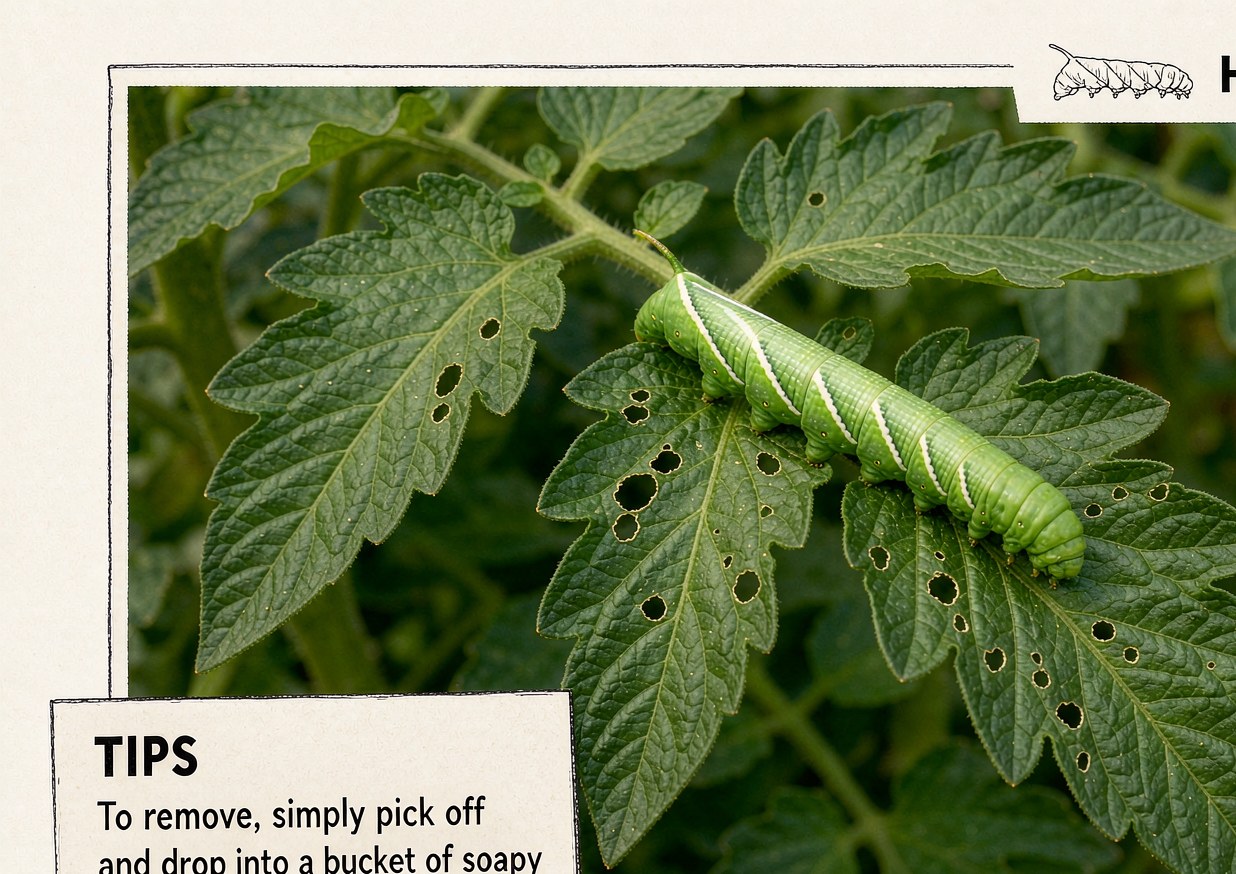 Photo provided by the author’s vegetable garden
What the caterpillar looks like
A tomato hornworm (Manduca quinquemaculata) is a big, fat, bright-green caterpillar with white diagonal stripes along its sides and a curved black or green “horn” on its rear end. Despite the name, the horn is not a stinger and it cannot hurt you — it is just a harmless nub. The similar tobacco hornworm (Manduca sexta) looks almost the same but has straight white stripes and a red horn. Both are the caterpillars of large brown sphinx moths (sometimes called hummingbird moths because of how they hover). These things get to the size of your thumb, which is why the damage shows up so fast.
The reason they are so hard to spot is pure camouflage. A hornworm is the same green as the tomato leaf it rests on, and it tends to lie flat along a stem rather than out in the open. The first one I ever found, I only noticed because I saw the leaf it was on move. Until then it had been invisible to me despite being two inches long. Knowing the shape — fat, smooth, with those stripes — is what finally let me scan a plant and pick them out in seconds.
Why they do so much damage so fast
A single hornworm can defoliate a medium tomato plant in a matter of days because it eats almost constantly and it is enormous relative to the leaves. They favor the top growth and new leaves, which is also where your fruit set is happening, so an unchecked hornworm does not just ugly up the plant — it knocks back your harvest. I have seen one caterpillar take a healthy four-foot plant down to bare stalks over a long weekend. That speed is exactly why a “check every few days” habit beats a “deal with it when I notice” habit.
The flip side is encouraging: because they are big and because they work the tender new growth, once you learn to look in the right places, you can usually remove every hornworm on a plant in under five minutes. They are not like aphids that hide in thousands of crevices; they are a handful of big, obvious (once you know the trick) targets. Hand control is genuinely the most effective approach here, which is why the rest of this article is built around your hands and a bucket rather than a sprayer.
How to Actually Find Them
Follow the damage, not the worm
The secret to finding hornworms is to stop looking for the caterpillar and start looking for evidence. The three tells are: (1) leaves with the soft tissue eaten away, leaving only ribs or bare stems; (2) black or greenish-black pellets of frass (caterpillar droppings) on the leaves below or on the soil; and (3) fruit with scooped-out bites taken from the shoulders. Where you see fresh damage and fresh frass, the worm is almost always within a foot of it, usually higher up. I now scan the top third of the plant first, because that is where they start.
Once you locate recent damage, look at the nearest intact leaf — hornworms rest on the leaves they have been eating and are the same color as them. Trace from the chewed leaf outward along the stem. The first season I used this method I went from finding zero worms to finding four on one plant in a single evening. The frass is the giveaway I had been missing; it is like a trail of breadcrumbs straight to the culprit.
Checking the leaf undersides and tops
Hornworms favor the upper, sunnier parts of the plant and often sit on the underside of a leaf or right along the main stem where the leaf meets it. So work top-down: inspect the top growth, then flip leaves over as you go down. They also tend to move to a fresh part of the plant once they have stripped one area, so if you cleared a plant and see new damage a few days later, re-scan the new growth. I keep a small hand lens in the garden basket — not because the worms are small, but because at a glance the stripes blend in, and a closer look confirms “worm” versus “vein shadow.”
A timing tip: hornworms feed most actively in the warm part of the day and are easiest to catch in the act then, but they are visible any time if you look. I do my hornworm patrol in the early evening with a flashlight some years, because the green-on-green is easier to read in raking side-light. Whatever time you pick, make it a rhythm — every two to three days from when the first fruits set until the plant winds down.
Hand-Picking: The Method That Works
 Photo provided by the author’s vegetable garden
Gloves or bare hands?
You can pick hornworms with bare hands — they are harmless to touch and the horn does not sting — but I wear light gardening gloves mostly because it is less gross to pluck a squishy caterpillar and drop it, and because tomato foliage can be irritating to some skin. Either way, the motion is simple: pinch the worm gently but firmly near the middle (they have grip, so a quick confident grab works better than a tentative one) and lift it off. They may wriggle; they will not bite or hurt you. The first time feels weird; by the fifth it is routine.
If a worm is draped across a fruit or a delicate shoot, support the stem with your other hand so you do not snap it while removing the caterpillar. I learned that the hard way when I yanked a worm and took a fruiting branch with it. Slow, steady, and one hand under the stem — that is the whole technique. No tools required beyond your hands and a container.
The bucket-of-soapy-water finish
Once you have the worm, do not just toss it on the ground a few feet away — it will climb back, or another gardener’s mistake is to assume it walks off. Drop it into a bucket of soapy water (a few drops of dish soap in a gallon or two of water). The soap breaks the surface tension and the caterpillars drown quickly; this is a humane, chemical-free kill and it keeps them from returning. I keep a dedicated “hornworm bucket” by the tomato bed all summer so I am never hunting for a container mid-patrol.
Some gardeners relocate worms to a far-away weed host like a distant horse-nettle or just squish them; the soapy bucket is my preference because it is contained and I am not tossing squished caterpillars back into the bed where they are upsetting to find later. Whatever finish you choose, the point is that a worm you remove must not get a second chance at your plants. Consistency here is what turns a hornworm problem into a non-event.
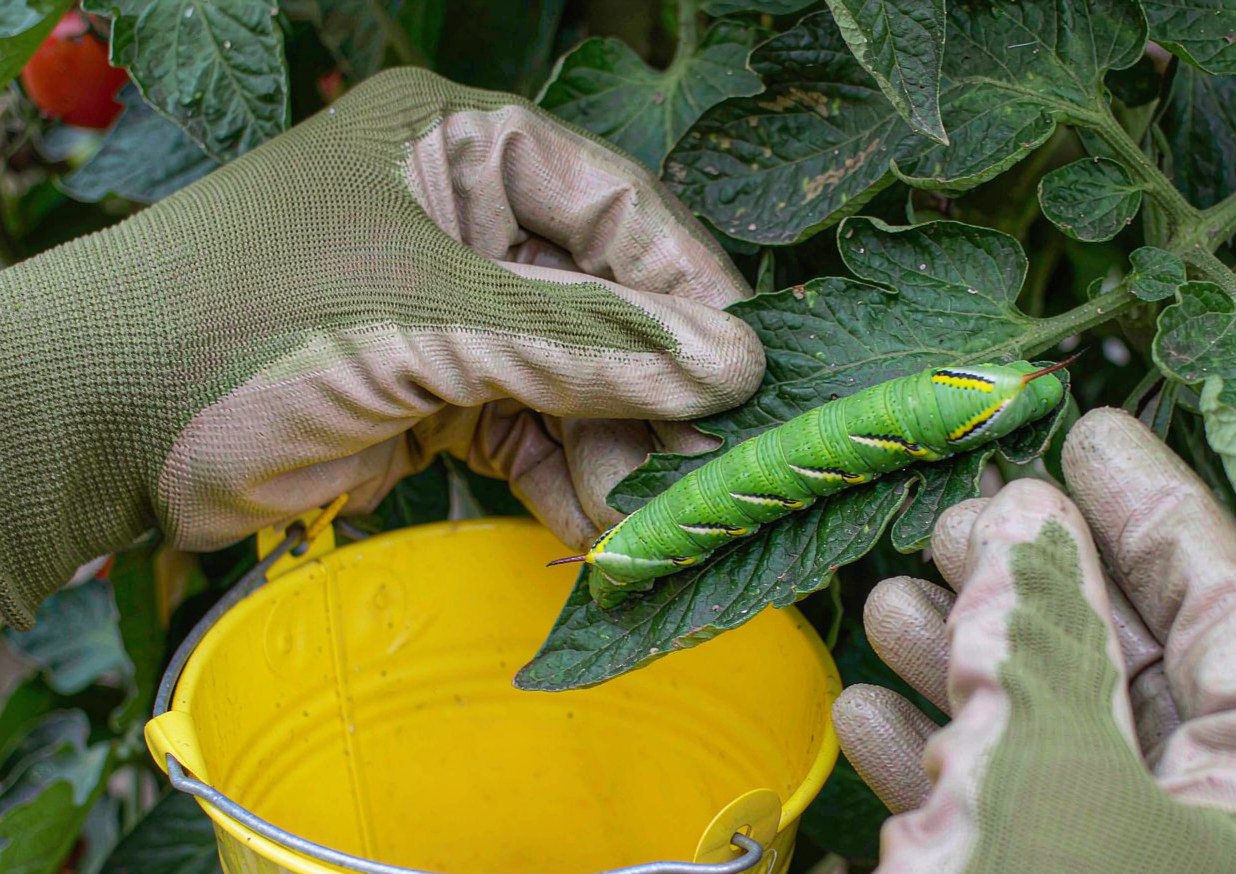 Photo provided by the author’s vegetable garden
What to Do With the Ones You Collect
Soapy water versus relocation
Soapy water is the cleanest disposal, but if you would rather not kill them, relocate them far from any solanaceous crop (tomatoes, peppers, eggplant, potatoes) — at least a few hundred feet, ideally to a wild area with no garden plants. The reason for the distance is that hornworms are strong and determined, and a worm dropped at the edge of the bed will be back. I only relocate when I have a kid visiting who wants to “save” the caterpillar; otherwise the bucket is final. Either approach is valid as long as the worm ends up where it cannot eat your harvest.
One thing I do not do is compost live hornworms — a compost pile is warm and they will pupate and the moth will come back to lay more eggs. If you compost, make sure they went through the soapy water first. The goal is to break the lifecycle at the stage you can see, and a live worm in the compost is the lifecycle continuing.
Don’t panic about the count
It is easy to feel like the infestation is enormous when you start finding worms, but in practice a tomato patch rarely has more than a handful per plant at a time. The damage looks bigger than the population because each worm eats so much. I have had years where I removed a total of maybe a dozen worms all season and still felt overrun, simply because each one left a bare stalk behind. Once removed, the plant recovers fast — tomatoes are vigorous and push new growth quickly — so do not over-react by reaching for the sprayer out of panic. Hand-pick, count, and move on.
The Braconid Wasp Trick (Leave Some Alone)
What the white cocoons mean
Here is the part that surprises everyone: if you find a hornworm covered in small white oval cocoons (they look like grains of rice stuck all over it), leave it alone. Those are the pupae of braconid wasps, tiny native parasitoids that laid their eggs inside the caterpillar. The wasp larvae ate the hornworm from the inside out and then spun those cocoons on its back. The hornworm is already dead or dying and will not eat another leaf — and if you leave it, dozens of beneficial wasps hatch and go hunt more hornworms for you. I now cheer when I see a cocoon-covered worm.
This is free, chemical-free biological control, and it is the single best reason not to blanket-spray your tomatoes. A spray that kills the hornworm also kills the wasps doing the real long-term work. The Michigan State Extension hornworm page and similar extension sheets point out that these parasitized worms are a sign your garden’s natural enemies are working, and you should let them be.
Encouraging the wasps
You can invite more braconid wasps by not spraying, by planting umbrella-flowered herbs like dill, parsley, and fennel that the adult wasps feed on, and by tolerating a little pest pressure so the wasps have hosts to work on. A garden with zero pests also has zero predator support. I let a patch of dill flower specifically for the beneficial wasps and hoverflies, and the hornworm pressure on my tomatoes dropped noticeably once the wasp population established. It is a slower, more elegant solution than any spray, and it compounds year over year.
Prevention for Next Season
Breaking the soil-borne cycle
Hornworms pupate in the soil at the base of the plant, then the moths emerge and lay eggs on the leaves. One of the most effective preventative steps is to till or turn the soil in that bed after the season (or grow tomatoes in a different spot next year), which disturbs the pupae and reduces the next generation. Crop rotation — not planting tomatoes, peppers, or eggplant in the same ground two years running — also starves the returning moths of their preferred host. I rotate my nightshade bed on a three-year loop and it visibly cuts hornworm numbers.
Mulching and cleaning up spent plants promptly at the end of the season removes hiding and pupation sites. The Illinois Extension tomato guide and other vegetable sheets emphasize sanitation and rotation as the backbone of hornworm (and general pest) prevention. None of this is glamorous, but it is what keeps the population from building up.
Starting clean and scouting early
Begin scouting as soon as the plants are a foot tall and keep it up through the fruit set, because the moths lay eggs on the undersides of leaves in early summer. Crush any tiny egg clusters you find (they are pale greenish-white spheres laid in groups) before they hatch. Early, light scouting means you intercept the first generation small, before it grows into the thumb-sized leaf-strippers. I treat the first warm weeks of summer as “hornworm watch” and it pays off every time.
Common Mistakes
Spraying first instead of looking
The biggest mistake is reaching for insecticide the moment you see damage, without ever laying eyes on the worm. Not only does this kill the beneficial wasps, it often misses the actual caterpillars (which are shielded under leaves) and leaves you with a half-solved problem and a chemical residue on your food crop. I made this mistake early on with a general spray that did nothing to the worm I still could not find. Hand inspection first, always — it is faster than you think and far more targeted.
The second mistake is the mirror image: seeing damage, pulling one worm, and assuming you are done, when there are usually several on a plant. Always do a full top-to-bottom scan after you find the first one, because where there is one there are often two or three. A partial pick gives the remaining worms the run of the plant.
Giving up on the plant
People often yank a hornworm-stripped tomato plant and toss it, thinking it is dead. Tomatoes are remarkably resilient: strip the worms, give it water and a little compost, and a defoliated plant will push a fresh flush of leaves within a week or two and still fruit. The plant I “lost” that first year would almost certainly have recovered if I had just found the worm and waited. Unless the stem is actually broken or diseased, do not give up — remove the pests and let the plant do what tomatoes do.
Companion Planting and Habits That Help
Plants that earn their spot
Companion planting will not magically eliminate hornworms, but a few plants pull their weight. Basil and marigold grown at the base of tomatoes are classic companions that can confuse or repel some pest pressure and never hurt. More useful for hornworms specifically: letting dill, parsley, and borage flower nearby feeds the parasitic wasps and predatory insects that take hornworms down. I interplant basil with every tomato and let one dill plant go to flower for the wasps, and the combination is part of why hand-picking alone is enough most years.
The honest framing, which I owe the reader, is that companion planting is support, not a substitute for scouting. The Oregon State gardening pages and university vegetable guides are clear that no companion plant replaces inspection. Use them to lighten the load, not to skip the bucket.
Habits that keep the pressure low
Beyond plants, two habits matter: water and feed consistently so plants grow fast and outrun damage, and patrol on a schedule rather than by panic. A vigorous, well-grown tomato shrugs off a hornworm or two; a stressed, slow one gets overwhelmed. I feed with a balanced tomato fertilizer and keep the bed mulched and evenly watered, and the plants simply recover faster when a worm does get through. The routine — scout, pick, support the wasps, rotate — is the whole system.
The Lifecycle, So You Can Time It
From moth to worm to moth again
Understanding the lifecycle is what lets you get ahead of hornworms. Adult sphinx moths emerge from soil-borne pupae in late spring or early summer, mate, and lay pale eggs on the undersides of tomato leaves. Those hatch into the caterpillars we are hunting. The caterpillars feed for two to three weeks, then drop to the soil to pupate, and a new generation of moths emerges a couple of weeks later — meaning you can get two or more generations in one growing season. Knowing this tells you why a single early-summer cleanup is not enough; you have to keep scouting all season.
The practical timing: start watching when plants are small, peak your scouting from fruit set through midsummer (when egg-laying is heaviest), and keep going until the plants slow down. The MSU tomato topic page and similar resources lay out this seasonal pattern, and it is the rhythm I build my patrols around.
Why timing your removal matters
Removing worms before they are full-size prevents most of the damage, because a worm does the bulk of its eating in its final few days. A small worm does little; a thumb-sized one does everything. So early, frequent scouting that catches them young is worth more than occasional heroic removal of giants. I would rather pick five half-inch worms than one three-inch one that already stripped a branch. Frequency beats force.
Hornworms vs. Other Tomato Leaf-Eaters
Telling them apart
Not every chewed tomato leaf is a hornworm. Slugs leave ragged holes and shiny trails and work low and at night; cutworms cut seedlings at the soil line; flea beetles pepper leaves with tiny shot-holes; and various looper caterpillars are smaller and loop as they crawl. The hornworm signature is large, smooth, green, striped, with a horn, plus abundant frass and wholesale defoliation of the top. Getting the ID right matters because the control differs — slugs need beer traps or grit, loops need different handling. The NC State Extension Gardener Handbook has identification keys for the common vegetable pests.
When in doubt, the frass-and-top-growth clue is the fastest differentiator: if the damage is at the top and there are black pellets, it is almost certainly a hornworm. I have mistaken early flea-beetle damage for hornworm exactly once, sprayed nothing, and felt silly — but the habit of confirming the pest before acting has saved me from wasted effort more often than not.
When several pests show up together
Mid-summer tomato plants often host more than one issue at once — hornworms plus early blight plus a few aphids. Deal with the hornworms by hand first (they are the fast movers), then assess the rest. Do not reach for a broad spray to “get everything,” because that also gets the wasps and the ladybugs. Targeted, manual control of the hornworms and tolerance of minor cosmetic issues is how a tomato bed stays productive without becoming a chemical treadmill. I prune out blighted lower leaves for airflow and hand-pick the worms, and that combination keeps the plants going.
A Note on Sprays and When to Skip Them
Why hand control is usually enough
For most home tomato patches, hand-picking plus the parasitic wasps is completely sufficient, and it keeps your fruit free of residue. A biological option some gardeners keep as a backup is a Bacillus thuringiensis (Bt) product — a naturally occurring bacterium that sickens caterpillars but is considered low-risk to people, pets, and beneficial insects when used as labeled. I mention it only as a backup for a genuinely overwhelming infestation; I rarely need it. The important point, given how easy hand control is, is that the sprayer should be the last resort, not the first.
I will not list mixing rates here on purpose: the safe approach is to buy a product labeled for caterpillars on tomatoes and follow that label exactly, because rates vary by product and over-application is both wasteful and unnecessary. Used well, Bt targets caterpillars and spares the wasps less than broad synthetics do — but hand-picking still wins on simplicity. For a typical backyard bed, the bucket beats the bottle.
Pet and child safety around the plants
A reassuring note: the hornworms themselves are harmless to handle and not toxic to pets — a dog that mouths one will be fine. The thing to watch is the tomato plant itself: tomato foliage and green (unripe) fruit contain solanine and are toxic to dogs, cats, and horses if eaten in quantity. So keep pets from grazing tomato leaves, but do not worry about the caterpillars. This is general gardening information, not veterinary advice: if you think a pet has eaten tomato foliage or anything else questionable, call your veterinarian or the ASPCA Animal Poison Control Center at (888) 426-4435. I keep my tomato bed where my dog does not browse, and I check the ASPCA tomato listing whenever I am unsure about a new plant near animals.
Troubleshooting: Symptoms, Causes and Fixes
Most hornworm situations trace back to one of six causes. This is the table I wish I had before that first stripped plant.
| Symptom | Likely cause | Fix |
|---|---|---|
| Leaves stripped overnight, bare stems, half-eaten fruit | One or more tomato hornworms feeding | Scan top growth and leaf undersides; hand-pick; drop in soapy water |
| Cannot find the worm despite clear damage | Camouflage; looking at plant not evidence | Follow frass (black pellets) and chewed leaves upward to the nearest intact leaf | Worm covered in white rice-like cocoons | Parasitized by braconid wasps (already dying) | Leave it; the wasps will control more hornworms |
| Damage returns a few weeks after cleanup | New generation of moths laid fresh eggs | Keep scouting every 2–3 days all season; crush eggs on leaf undersides |
| New holes but no big green worm present | Different pest: slugs, flea beetles, or loopers | Match the pest (trails, shot-holes, looping) before acting |
| Hornworms keep coming back year after year | Pupae overwintering in the same soil | Till/rotate the bed; do not plant tomatoes in the same spot next year |
FAQs
Are tomato hornworms dangerous to touch or to pets?
No. The hornworm’s “horn” is a harmless nub, not a stinger, and the caterpillars are safe to handle and not toxic to pets. The plant is the part to watch: tomato leaves and green fruit contain solanine and are toxic to dogs, cats, and horses if eaten in quantity. This is general information, not veterinary advice — if a pet eats tomato foliage, call your vet or the ASPCA Poison Control hotline at (888) 426-4435. Handle the worms freely; keep pets from grazing the leaves.
How do I find hornworms if I can never see them?
Stop looking for the worm and look for evidence: chewed leaves with only ribs left, black frass pellets beneath the damage, and scooped bites out of fruit. The worm is almost always within a foot of fresh damage, usually higher up and on the underside of a leaf, the same green as its resting leaf. Once I started following the frass instead of scanning blindly, I went from finding none to clearing several per plant in one evening.
What should I do with hornworms after I pick them?
Drop them into a bucket of soapy water (a few drops of dish soap in a gallon or two). The soap breaks surface tension and they drown quickly — a humane, chemical-free kill that keeps them from climbing back. Do not just toss them on the ground nearby, and do not compost them alive, or they will pupate and return. If a worm is covered in white cocoons, leave it entirely alone; those are parasitic wasps finishing the job.
Will a hornworm-stripped tomato plant recover?
Yes, usually fast. Tomatoes are vigorous and push a fresh flush of leaves within a week or two once the worms are gone and the plant is watered and fed. Do not yank a defoliated plant assuming it is dead — unless the stem is broken or diseased, remove the pests and let it regrow. The plant I thought I had lost that first year would have recovered if I had just found the worm in time.
Should I spray my tomatoes for hornworms?
Usually not. Hand-picking plus naturally occurring parasitic wasps controls hornworms in most home gardens without residue on your fruit. A biological Bt product (used strictly per its label) is a backup for an overwhelming infestation, but the sprayer should be the last resort, not the first, because sprays also kill the beneficial wasps doing the long-term work. Scout every few days and pick by hand — it is simpler and more effective than most people expect.
Sources and Further Reading
- Michigan State University Extension — Tomato Hornworms
- Michigan State University Extension — Tomato Topic
- Illinois Extension — Tomato (vegetable guide)
- ASPCA — Tomato (Toxic and Non-Toxic Plants)
- Oregon State University Extension — Gardening
- NC State Extension Gardener Handbook
About the author
Samantha has been gardening and arranging her own cut flowers for more than ten years, and has built more than 30 centerpieces from grocery-store bunches, clippings off the cedars behind her house, and a handful of dollar-store experiments that didn’t work. She writes practical, low-cost guides for beginners, including the versions that failed. Prices quoted in her articles are what she actually paid at US grocery and craft stores; nothing is sponsored and no brand pays for a mention. She is not a certified florist, a veterinarian or a horticulturist, and says so wherever a topic touches on plant safety or pet health.
Published: Oct 30, 2026 · Last updated: Oct 30, 2026.
{
“@context”: “https://schema.org”,
“@graph”: [
{
“@type”: “Article”,
“headline”: “Tomato Hornworms: How to Find and Remove Them by Hand”,
“description”: “A tomato hornworm can strip a plant in days, but hand-picking is the most effective control. Learn how to find them by their damage, remove them safely, and use parasitic wasps to your advantage.”,
“image”: [
“images/hornworm-hero-clean.jpg”,
“images/hornworm-tools-clean.jpg”,
“images/hornworm-process-clean.jpg”
],
“author”: { “@type”: “Person”, “name”: “Samantha” },
“publisher”: { “@type”: “Organization”, “name”: “gmmur” },
“datePublished”: “2026-10-30”,
“dateModified”: “2026-10-30”,
“mainEntityOfPage”: {
“@type”: “WebPage”,
“@id”: “https://gmmur.com/tomato-hornworms-find-remove-by-hand”
}
},
{
“@type”: “FAQPage”,
“mainEntity”: [
{
“@type”: “Question”,
“name”: “Are tomato hornworms dangerous to touch or to pets?”,
“acceptedAnswer”: {
“@type”: “Answer”,
“text”: “No. The horn is a harmless nub, not a stinger, and the caterpillars are safe to handle and not toxic to pets. The tomato plant itself is the concern: leaves and green fruit contain solanine and are toxic to pets if eaten in quantity. If a pet eats tomato foliage, call your vet or the ASPCA Poison Control hotline at (888) 426-4435. This is general information, not veterinary advice.”
}
},
{
“@type”: “Question”,
“name”: “How do I find hornworms if I can never see them?”,
“acceptedAnswer”: {
“@type”: “Answer”,
“text”: “Look for evidence rather than the worm: chewed leaves reduced to ribs, black frass pellets beneath the damage, and scooped bites in fruit. The worm is almost always within a foot of fresh damage, usually higher up and on the underside of a leaf, the same green as its resting leaf. Following the frass is the fastest way to locate them.”
}
},
{
“@type”: “Question”,
“name”: “What should I do with hornworms after I pick them?”,
“acceptedAnswer”: {
“@type”: “Answer”,
“text”: “Drop them into a bucket of soapy water; the soap breaks surface tension and they drown quickly, a humane chemical-free kill. Do not toss them nearby or compost them alive, or they will pupate and return. If a worm is covered in white cocoons, leave it alone — those are parasitic wasps finishing the job.”
}
},
{
“@type”: “Question”,
“name”: “Will a hornworm-stripped tomato plant recover?”,
“acceptedAnswer”: {
“@type”: “Answer”,
“text”: “Usually yes, and quickly. Tomatoes are vigorous and push a fresh flush of leaves within a week or two once the worms are removed and the plant is watered and fed. Do not yank a defoliated plant unless the stem is broken or diseased; remove the pests and let it regrow.”
}
},
{
“@type”: “Question”,
“name”: “Should I spray my tomatoes for hornworms?”,
“acceptedAnswer”: {
“@type”: “Answer”,
“text”: “Usually not. Hand-picking plus naturally occurring parasitic wasps controls hornworms in most home gardens without residue. A biological Bt product (used strictly per its label) is a backup for an overwhelming infestation, but the sprayer should be the last resort because sprays also kill the beneficial wasps. Scout every few days and pick by hand.”
}
}
]
}
]
}